A manufacturer in Angelina County needs a new logo before a trade show. Their marketing coordinator, pressed for time and short on budget, opens an AI image generator on a Tuesday afternoon, types a few prompts, and by Wednesday morning has something that looks clean, modern, and entirely usable. It goes on the trucks. It goes on the building sign. It goes on ten thousand business cards. Nobody asks who owns it, because the question never occurs to anyone. The logo works. The invoice is paid. Everyone moves on.
Then, eighteen months later, a competitor two counties over starts using something that looks almost identical. Or a print shop flags that the image resembles stock art already licensed to someone else. Or the company simply wants to stop a knockoff and finds out, to its considerable surprise, that the lawyer they call has a harder time answering “can I protect this” than anyone expected.
This is not a hypothetical for shock value. It is the quiet, unglamorous risk sitting underneath a huge and growing share of the marketing material small businesses are producing right now. AI tools have become genuinely useful for logos, ad images, product photography mockups, marketing copy, and social graphics. Deep East Texas churches are generating sermon-series graphics with them. Manufacturers are using them for spec-sheet mockups. Ad agencies, including ones down the road from MSGPR, are using them for concept exploration before a shoot. The tools are good, and they are only getting better. But ownership of what comes out of them is one of the least settled questions in American business law today, and almost nobody using these tools day to day has stopped to ask about it.
This article is a plain-spoken walk through what is actually known, what is genuinely unsettled, and what a business owner can do right now to manage the risk sensibly, without paranoia and without pretending the uncertainty isn’t real.
Can you actually own something an AI made?
Start with the most basic question, because it is the one almost nobody asks until it matters: if you generate an image or a piece of copy with an AI tool, do you own it the way you own something a designer or copywriter creates for you?
The honest answer is: it depends, and the law is still working this out.
For as long as American copyright law has existed, protection has been tied to human authorship. Copyright grew up as a system for rewarding and protecting the creative choices a person makes: what to include, what to leave out, how to arrange it, what to emphasize. The US Copyright Office has published guidance addressing how this framework applies to AI-generated material, and the consistent theme is that copyright protection depends on there being a human being who exercised genuine creative judgment in the work. Purely AI-generated output, meaning content produced by typing a prompt and accepting whatever the tool hands back with no further human creative shaping, faces real and documented uncertainty about whether it can be protected at all.
Put more bluntly: if a machine did essentially all of the creative work and a person just pushed the button, there is a meaningful chance that output cannot be copyrighted by anyone. Not by the business that generated it, and not by the AI company that built the tool. It may simply sit outside the copyright system entirely, similar to how a work firmly in the public domain sits outside it.
That should stop a business owner cold for a second, because it changes the calculus. A logo you cannot register or defend is not really an asset in the way a business owner assumes a logo to be. It is a graphic you are using, which is not nothing, but it is not the same as owning a protectable piece of intellectual property that you can stop a competitor from copying.
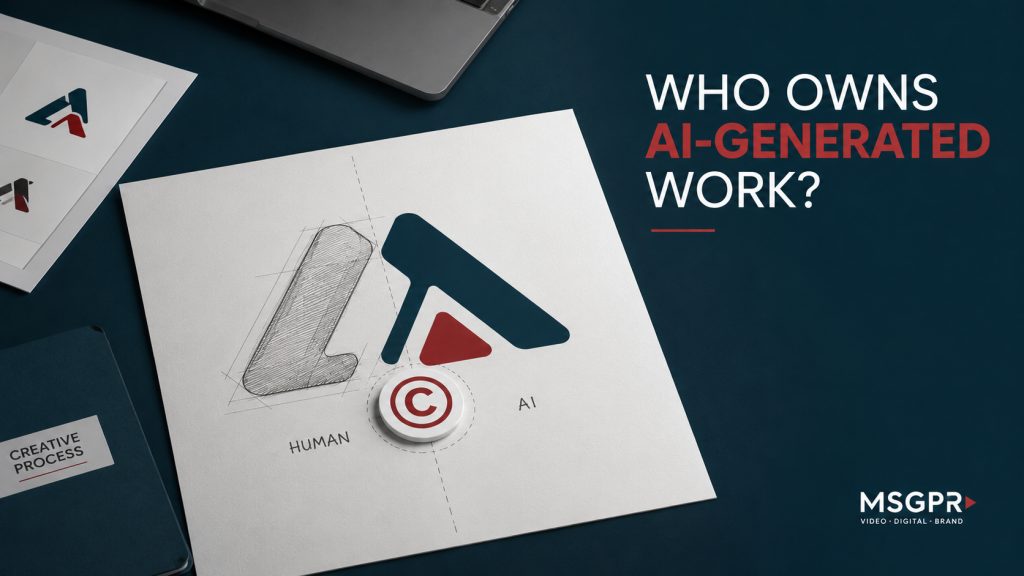
Here is the sentence worth remembering from this whole article: if you cannot say what a human contributed, you may not be able to say you own it.
What “meaningful human contribution” probably means
The law has not drawn a bright, numeric line here, and anyone who tells you it has is overstating what is actually settled. But the general direction of the guidance and the underlying legal principle points toward a distinction between two different things a business might do with AI.
On one end, you type a prompt, generate an image, and use exactly what came out with no further editing, selection, or combination. That is closer to the unprotectable end of the spectrum.
On the other end, you use AI as one tool among several in a genuinely human creative process: you generate several options, select and reject based on your own judgment, combine elements, edit, adjust composition or color, layer in original photography or copy, direct significant revisions, and shape the final piece through a series of human decisions that reflect your own creative choices. That is a meaningfully different situation, and the more of that human decision-making is present and documented, the stronger the case that the resulting work reflects real human authorship.
This is why documentation matters more than most business owners realize. Not because a designer needs to justify their invoice, but because if ownership is ever questioned, the business needs to be able to show its work. Save the prompt history. Save the intermediate drafts. Keep notes on what a human changed, combined, rejected, or directed. A brand design team that treats AI as a starting point and layers in real editorial and creative judgment on top of it is standing on much firmer ground than one that treats the first AI output as the finished product.
Practically, this looks like what a good creative process should look like anyway: iteration, editing, human judgment, a paper trail. The businesses that were already working this way with human designers do not need to change much. The businesses that started treating AI tools as a vending machine for finished creative are the ones with exposure.
The flip side: can AI-generated content get you sued?
Ownership is only half the picture, and it is arguably not even the scarier half. The other question is whether using AI-generated content can expose a business to a claim that it infringed on someone else’s copyrighted work.
Here is the plain-language version of what is going on. AI image and text generators are trained on enormous datasets, much of which includes copyrighted material scraped or licensed from across the internet: photographs, illustrations, articles, designs, and more. There is active, ongoing litigation in US courts over whether and how that training process itself involves copyright infringement, and how the fair use doctrine applies to it. That litigation has not reached a settled, uniform answer, and reasonable people, including judges, disagree about how it should come out. This is genuinely unresolved law, not a technicality being ironed out at the edges.
Separately from the training-data question, there is the output question, which matters more directly to a business owner using these tools day to day. Sometimes an AI generator produces an output that resembles a specific existing copyrighted work closely enough to raise a real infringement concern, particularly if the tool was prompted in a way that pulled hard toward a recognizable style, character, or specific existing image. A business that generates an ad graphic that turns out to closely echo an identifiable illustrator’s copyrighted piece, or a piece of marketing copy that lifts distinctive, protectable phrasing from an existing source, is not protected from a claim just because “the AI made it.” The tool being AI does not immunize the output, and it does not shift legal responsibility away from the business that used and published it.
Think of a Lufkin manufacturer’s website team generating a hero image for a new product line, and the resulting image looking suspiciously close to a specific stock illustration the AI happened to have seen many times in training. Or a nonprofit’s social media graphics team generating an image that lands close to a well-known artist’s identifiable visual style applied to a specific composition. These are the scenarios where the risk lives, and they are hard to fully eliminate because a business generally has no visibility into what a given AI model was trained on or how closely a given output tracks any particular source.
Practical risk management for a small business, starting now
None of this means AI tools are off-limits, and MSGPR is not in the business of scaring clients away from tools that are, used well, genuinely valuable. It means being deliberate. Here is what that looks like in practice.
Document human creative input as a matter of routine, not as an afterthought. When a designer or copywriter uses an AI tool as part of a project, keep a record of the process: the prompts, the iterations, the edits, the decisions made along the way. This protects the business two ways at once. It builds a stronger case for ownership if that question ever comes up, and it creates a paper trail showing the work was shaped and directed by a person, which matters if an infringement question ever comes up from the other direction.
Be cautious about outputs that closely resemble a specific existing work. If an AI-generated image or piece of copy looks like it could be mistaken for something you have seen before, whether a specific illustrator’s work, a well-known photograph, or an identifiable brand’s material, treat that as a signal to change direction, not a coincidence to shrug off. This is the single easiest risk to manage, because it just requires someone on the team to look at the output with a critical eye before it goes to print or goes live.
Keep records generally. Save source files, prompt logs, licensing terms for the tools used, and version history. This is unglamorous, and it is exactly the kind of thing that saves a business real money and real stress if a dispute ever arises, because the alternative is trying to reconstruct a creative process from memory months or years later.
Use reputable tools with clear licensing terms, and actually read those terms. AI platforms vary significantly in what they promise about training data, output ownership, and indemnification if a user gets challenged over an output. Some vendors offer meaningful commercial protections. Others offer none. This is worth ten minutes of a business owner’s time before committing a brand identity to a particular tool.
Do not assume “the AI made it” resolves the ownership question either way. It is tempting to think of AI-generated content as either fully yours because you paid for the tool, or fully safe because a machine did it and machines cannot be sued. Neither is accurate. The business that generated the content, and the business that publishes and profits from it, is the one holding the risk and the one that needs to think about it clearly.
Where this leaves a business owner
None of this is a reason to avoid AI tools. It is a reason to use them the way MSGPR has always encouraged clients to approach any new tool: with clear eyes, a real process behind it, and enough documentation that a business can explain, if it ever needs to, exactly how a piece of creative work came to exist and who shaped it.
This is also, honestly, one of the more interesting moments to be paying attention to this landscape. The legal framework is being actively written right now, through Copyright Office guidance and through court cases that have not yet resolved. A business that treats this as background noise is taking on risk it does not need to take on. A business that stays informed, even loosely, is in a much stronger position, both to protect what it creates and to avoid stepping into someone else’s rights by accident.
This is exactly the kind of terrain where it helps to work with people who are paying attention to it as part of their job, rather than trying to track it yourself in the gaps between running a business. MSGPR’s video, digital, and brand design teams use AI tools thoughtfully, as one part of a documented creative process rather than a shortcut around one, and we keep our clients informed as this legal landscape develops, because it is still developing. If your business is using AI tools for logos, ad creative, marketing copy, or anything client-facing, and you want a second set of eyes on how that work is being produced and protected, give us a call at 936-637-7593 or find us at msgpr.com. We would rather have that conversation now than after something has already gone out the door.
One last, necessary note. This article is general information about a genuinely unsettled area of law, not legal advice, and it should not be treated as a substitute for talking to an attorney about your specific situation. If your business has a real question about ownership of AI-generated material, or concern about a specific piece of content, the right move is to consult a lawyer who can look at your facts directly. The law here is moving, and moving targets deserve real legal counsel, not a blog post, however well researched.
Sources
- US Copyright Office, public guidance on artificial intelligence and copyrightability, addressing the human authorship requirement and the copyright status of AI-generated works. Referenced generally; consult the Copyright Office’s current published guidance directly for the latest position.
- Ongoing United States litigation concerning AI training data, generative AI outputs, and fair use, referenced generally to reflect that this area of law remains actively contested and unresolved in the courts as of this writing.
- This article is provided as general information for business owners and is not legal advice. Businesses with specific concerns about AI-generated content, ownership, or potential infringement should consult a qualified attorney.