Around 1440, in a workshop in Mainz, a goldsmith named Johannes Gutenberg solved a problem that had limited written communication for the entire span of recorded history up to that point: a single page of text could now be reproduced hundreds of times, identically, without a scribe’s hand touching every copy. Before movable type, a book was a singular, laborious object, and written communication traveled only as fast and as far as someone was willing to copy it by hand. After Gutenberg, a page could scale. That single shift, the ability to reproduce the written word reliably and at volume, is the hinge on which the modern information age turns, and it is worth pausing on before you finalize this fall’s marketing budget, because your inbox is currently suffering from the opposite problem Gutenberg solved.
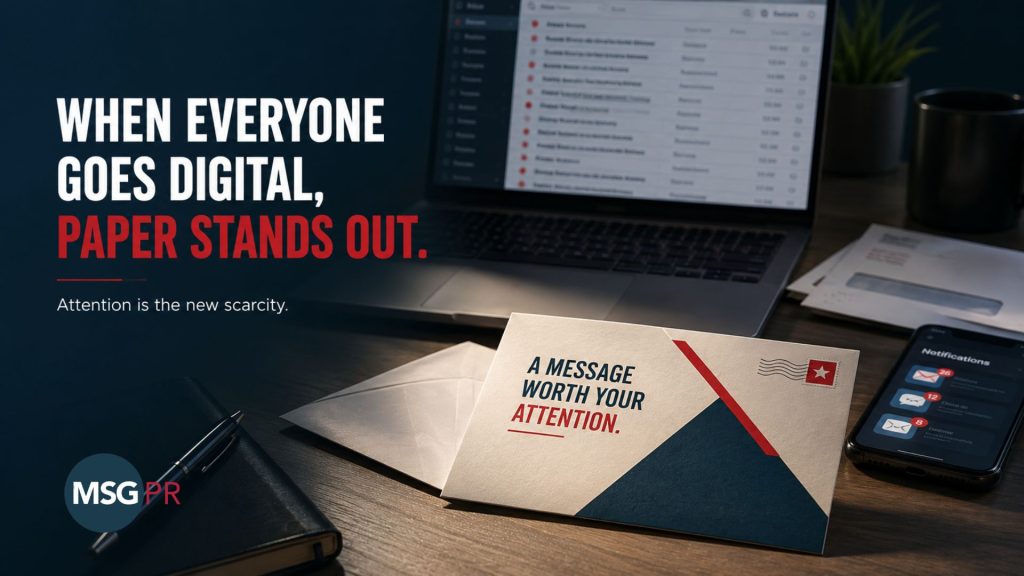
Gutenberg made scarcity disappear. What you’re dealing with right now, in a business or a ministry trying to reach customers or donors through a smartphone screen that already holds forty unread messages, is what happens when scale becomes so complete that scarcity vanishes entirely and takes attention with it. When everyone can reach everyone instantly, at effectively zero marginal cost, being able to send a message stops being the advantage. Being noticed becomes the advantage. That is the strange, quiet twist in this story: the technology that made mass communication possible in the first place is also, five centuries later, the reason a piece of paper in a mailbox can now out-communicate a hundred emails in an inbox. Scarcity moved. It didn’t disappear.
What Gutenberg actually changed
It’s tempting to treat the printing press as a distant historical curiosity, the kind of fact that shows up in a textbook and stays there. But the historian Elizabeth Eisenstein, in her landmark study The Printing Press as an Agent of Change, made the case that movable type didn’t just speed up book production, it restructured how knowledge itself moved through society. For the first time, a text could be fixed, standardized, and distributed widely enough that readers in different cities could argue over the same exact wording rather than a scribe’s approximation of it. Ideas that once traveled at the speed of a single copyist’s pen suddenly traveled at the speed of a print run. Eisenstein’s argument is that this shift in the mechanics of reproduction had consequences far larger than the technology itself, reshaping the Reformation, the Scientific Revolution, and the entire intellectual infrastructure of the modern world, because it fundamentally changed who could access a fixed, reliable, reproducible text and how fast.
That’s the part of the story most people know, in outline if not in Eisenstein’s detail. Here’s the part worth sitting with for a business owner in 2026. Every technology that scales communication follows a similar arc: it starts by making a channel dramatically more valuable, because suddenly a message can reach far more people than it used to. Then, as more and more senders adopt it, the channel gets crowded, and the value of any single message in that channel declines. The printing press took roughly a century to move from revolutionary scarcity to the ordinary background noise of a literate world flooded with pamphlets, broadsides, and competing claims. Email took about a decade. Social media took less than that. Each new channel promises to cut through the noise of the last one, right up until it becomes noise itself.
That is not a reason to distrust every new channel. It is a reason to notice, clearly and without nostalgia, when an old channel has quietly become the uncrowded one again.
The paper signal in a saturated inbox
Here is the plain arithmetic behind that claim. The average person’s email inbox is a triage environment, dozens of messages a day, most opened for less than two seconds before being deleted, archived, or ignored, with spam filters silently disposing of a meaningful share before a human ever sees them. A mailbox is a different kind of space entirely. Most households receive a handful of pieces of mail on a given day, not a hundred. Every one of those pieces has to be physically handled, at minimum glanced at, before it’s sorted into keep or toss. That single structural difference, low volume versus high volume, physically handled versus scrolled past, is why a channel that businesses have spent the last fifteen years quietly deprioritizing has become, almost by accident, one of the least crowded ways to reach someone’s actual attention.
When almost everyone else has stopped sending something, sending it well becomes a competitive advantage in itself.
This is the authority gap showing up in a mailbox instead of a boardroom. Most businesses and ministries that struggle to be heard don’t actually have a message problem. They have a channel-crowding problem, and the fix isn’t always a louder message, it’s sometimes a quieter channel where the message doesn’t have to compete with forty others for the same three seconds of attention. A well-designed piece of mail, in a world where fewer of your competitors are sending one, starts every interaction with something email simply cannot buy back: a moment of individual, physical attention before the reader has decided whether you’re worth their time.
What the research actually shows
That’s the intuitive case. The measured case is stronger, and it comes from research the postal industry itself commissioned, which is worth flagging honestly before citing it, because the sponsor has an obvious interest in the results looking favorable. That said, the findings hold up on their own terms and align with independent industry response data, so they’re worth taking seriously rather than dismissing on conflict of interest alone.
A research series from the USPS Office of Inspector General, conducted in partnership with Temple University’s Center for Neural Decision Making, used neuroscience methods to compare how people’s brains process physical mail against digital advertising. The finding that matters most for a marketing budget: physical ads require meaningfully less cognitive effort to process than their digital equivalents. Less cognitive effort translates into faster, deeper encoding, which is a fairly technical way of saying the brain registers a physical object as real and present with less mental friction than it takes to register a banner ad competing with a dozen open browser tabs. A postcard on the kitchen counter isn’t fighting anything else for attention. It just sits there, tangible, until someone deals with it, and dealing with it is itself a small act of engagement an email delete never requires.
Layer the ANA and Data & Marketing Association’s response rate research on top of that, and the picture becomes even harder to argue with. Direct mail continues to outperform email by a wide margin on response rate, piece for piece and message for message. That’s not a nostalgia statistic. It’s the industry’s own benchmark data, tracked year over year by the organizations whose members are betting real budgets on the answer, and it keeps landing in the same place: a physical piece of mail, delivered to the right list, gets acted on at a rate email simply does not reach anymore. Put the neuroscience and the response data together and you get a coherent story rather than two disconnected numbers. Mail gets picked up because it demands a physical decision. It gets processed with less mental friction because it’s a tangible object rather than a screen item competing for attention among a dozen others. And it gets acted on more often because both of those things are true at once.
None of this means digital communication is worthless, and nothing here is an argument for abandoning email or social media. It’s an argument for recognizing that the channel your competitors have mostly walked away from is, for exactly that reason, less crowded than the one they’re all still fighting over.
What fall planning season should actually look like
Late August is when a lot of Deep East Texas businesses start assembling their fall marketing calendar, and direct mail is usually the line item that gets cut first, not because it doesn’t work, but because it’s the one nobody’s revisited the math on in a few years. Before you finalize that calendar, it’s worth walking through what a genuinely well-planned fall mail effort looks like, because the difference between a mail campaign that pays for itself and one that quietly underperforms almost never comes down to the channel. It comes down to the planning.
Start with the list, not the design. A general-purpose mailer sent to every household in a zip code will always underperform a tighter list built around an actual criterion, past customers, a defined service area, a specific industry segment, because the response-rate advantage mail carries is strongest when it’s landing with people who already have some reason to care. A regional HVAC company mailing a pre-winter maintenance offer to households it has serviced in the last three years is working a list where even a modest response rate produces real revenue. The same company blasting a purchased list of every address in the county is fighting uphill against exactly the same crowding problem digital channels have, just with a higher price tag per piece.
Time it to something real. Fall gives a business or ministry a natural sequence of reasons to be in someone’s mailbox that don’t feel like an ad: back-to-school and pre-holiday planning windows for retail and service businesses, year-end giving season ramping up for non-profits and ministries, open enrollment season for healthcare and benefits-adjacent businesses, and the general seasonal shift that makes a maintenance reminder, a holiday preview, or a year-end appeal feel timely rather than intrusive. A piece that arrives with a reason attached performs differently than one that arrives as an interruption.
Design it to be handled, not glanced at. The cognitive-effort research above describes an advantage physical objects carry generally, but a thin, cluttered, poorly designed piece forfeits a real share of that advantage before the reader ever gets to the offer inside. The paper stock, the layout, the legibility of the type, all of it either reinforces or undercuts the credibility signal the medium is already giving you for free. A well-produced piece earns the extra few seconds of attention the format has bought it. A cheap-feeling one spends that advantage down before the message even lands.
Print and digital together, not print instead of digital
The mistake underneath most of this planning conversation is treating mail and digital as a choice, when the businesses actually getting results from both are sequencing them together, letting each channel do the part it’s genuinely good at. A well-designed direct mail piece drives a specific, trackable next step, a phone number, a QR code, a landing page built just for that campaign, and the response to that piece feeds an email sequence and a retargeting effort aimed at the people who engaged but didn’t yet convert. The mail piece earns the attention and the credibility. The digital layer handles the frequency and the lower-cost follow-up that email genuinely does well. Neither channel is being asked to do the other’s job, which is precisely where most single-channel plans quietly fail.
A Lufkin-area church we’ve worked with runs exactly this kind of sequence every fall: a physical invitation mailed to households in its growth corridor ahead of its harvest festival, paired with a QR code that routes to an event page and a follow-up email series for anyone who registers. The mail piece isn’t competing with the church’s social media presence or its email newsletter. It’s doing the job neither of those channels can do as well, landing in a stranger’s hand with enough physical presence to be worth a second look before the digital layer takes over the relationship. That’s not an either-or decision. It’s a sequence, and it’s the same sequence a well-run fall campaign for a business looks like, just with a different offer at the center of it.
Where this leaves your fall calendar
Gutenberg didn’t invent scarcity. He removed it from the written word, and it took five centuries, several new technologies, and an inbox holding forty unread messages before scarcity found its way back to paper. That’s the whole argument in one sentence: the channel most businesses have quietly stopped using is, for exactly that reason, less crowded than the one everyone else is still fighting over. The USPS and Temple University research on cognitive processing and the ANA/DMA response rate data both point the same direction, and neither one requires you to abandon email, social, or digital advertising to act on it. It requires treating this fall’s mail plan as a deliberate part of the calendar rather than the line item that gets cut when the budget gets tight.
MSGPR designs and produces direct mail that stands out precisely because almost nobody else is sending it anymore, list strategy, copywriting, design, and print production, built to work as one piece of a plan that includes your digital effort rather than compete with it. If your fall calendar has a gap where mail used to be, now is the time to fill it before the season gets away from you. Call 936-637-7593 or visit msgpr.com, and let’s build a piece worth picking up.
Sources
- Elizabeth Eisenstein, The Printing Press as an Agent of Change, Cambridge University Press.
- USPS Office of Inspector General, research series with Temple University’s Center for Neural Decision Making, on the cognitive processing of physical versus digital advertising.
- ANA (Association of National Advertisers) / DMA (Data & Marketing Association) Response Rate Report data comparing direct mail and email response rates.