1. The paradox: a good year that isn’t
Picture a development director at a mid-size non-profit in Deep East Texas, sitting down in early January to close out the books on the year before. By the numbers she reports to her board, it was a strong one. The annual food distribution event brought in more first-time donors than any year on record. A local news segment on the organization’s mobile pantry route generated a nice bump in online gifts. The spring gala hit its revenue goal for the third year running. Every slide in her year-end board presentation points up and to the right.
And yet, when she pulls up the full donor file, something doesn’t add up. The total number of active donors, people who have given at least once in the past eighteen months, is almost exactly where it was two years ago. Some of the names have changed. A lot of last year’s first-time donors are simply gone, replaced by this year’s crop of first-time donors, who will very likely be gone themselves by next January. The organization is running hard and staying in place.
This is not a story about an organization doing anything obviously wrong. It’s a story about an organization that has, like most non-profits, built a communications program almost entirely around the front half of the donor relationship: getting someone to give the first time. What happens after that first gift, whether it grows into a relationship or evaporates into a one-time transaction, has never been treated as its own discipline with its own budget line, its own calendar, and its own accountability to the board. It has been left to happen on its own. And things left to happen on their own, in fundraising as everywhere else, tend not to happen.
A non-profit that is good at acquiring donors and indifferent to keeping them is not growing. It is replacing.
That distinction, between growing and replacing, is the organizing idea behind this guide. It is written for the executive director, development officer, church communications director, or board member who has felt the gap between “our numbers look fine” and “our numbers don’t seem to be compounding the way they should.” What follows is the full arc: what the national giving data actually says, where the donor pipeline leaks, how to build a stewardship system that plugs the leak without adding headcount, where digital channels fit for an organization with limited staff time, how governance and volunteers factor into the whole picture, and a practical self-assessment you can run against your own program this week.
2. The state of giving: a healthy top line hiding an unhealthy foundation
Any conversation about the health of the non-profit sector has to start with Giving USA, the longest-running and most cited annual measure of American charitable giving. Giving USA’s 2026 report puts total charitable giving in the United States at a figure north of $600 billion, spread across individuals, foundations, bequests, and corporations. It is, by any historical measure, an enormous river of generosity, and it is tempting to read a number that size as evidence that the sector, broadly, is thriving.
That temptation is worth resisting, because a strong national total can coexist with a badly weakened foundation underneath it, in the same way a healthy-looking GDP can coexist with a shrinking middle class. Giving USA’s data has shown a persistent, well-documented pattern over the past decade: total giving has been sustained less by a broad, growing base of everyday donors and more by a shrinking number of larger gifts from a wealthier, more concentrated set of donors. The total dollar figure holds up. The number of individual households who give at all has been declining for years. Fewer people are carrying more of the sector’s weight.
For a local non-profit or ministry, that national trend has an uncomfortable local translation. Depending on a handful of major donors for an outsized share of your budget is fragile in a way that a broad base of loyal, mid-level donors is not. One major donor’s changed circumstances, a business downturn, a shift in giving priorities, a move out of the area, can create a hole that takes years to fill. A base of two hundred donors who have given for five straight years is a far more durable asset than the same total dollar amount concentrated in five gifts, even though the second scenario often looks more efficient on a spreadsheet. The top-line giving number tells you the sector still has money moving through it. It does not tell you whether any individual organization’s donor base is actually healthy, and healthy, for a non-profit, means broad, engaged, and returning, not just large.
This is the first reframe this guide asks you to make: stop asking “how much did we raise” as the primary question, and start asking “how many of the people who gave last year gave again this year.” The first number is what gets reported to the board. The second number is what actually predicts whether the organization is stable five years from now.
3. The acquisition-to-retention pipeline: where organizations actually lose donors
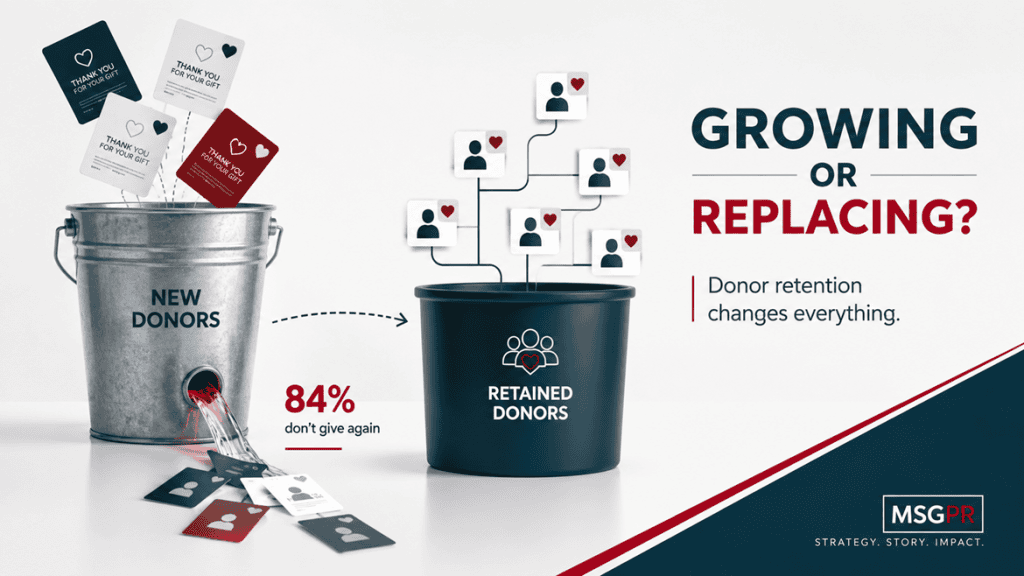
The Fundraising Effectiveness Project, a joint research initiative of the AFP Foundation for Philanthropy and GivingTuesday’s Data Commons, has spent years tracking what happens to donors after that first gift clears, across thousands of participating organizations. Its findings are the most sobering, and most useful, data point in this entire guide. The FEP’s research consistently finds that new-donor retention across the sector sits somewhere around 16%, meaning that for every one hundred first-time donors an organization brings in this year, roughly eighty-four of them will not give again. This figure has held remarkably steady for years, across organization sizes and causes, which tells you it is not a fluke of any one bad year. It is how the sector, as a whole, currently operates.
Sit with that number rather than skim past it. It means the overwhelming majority of the acquisition effort, the direct mail piece, the year-end social campaign, the gala invitation, the online ad that finally converted a stranger into a donor, is producing relationships that end almost as soon as they begin. The acquisition worked. The relationship didn’t. And because acquisition is the visible, campaign-driven, board-celebrated activity, while retention is the quiet unglamorous work of a handwritten thank-you note or a February impact email that nobody is tracking toward a hard goal, organizations keep reinforcing the part of the pipeline that is already working and neglecting the part that is actually broken.
This is the “leaky bucket” problem, and it is worth being precise about what it means in practice. A bucket with a hole in the bottom can still look full if you pour water in fast enough. That is exactly what is happening at the development director’s organization from the opening scene: acquisition is strong enough to mask a retention problem, right up until acquisition slows down even slightly, a bad economic year, a leadership transition, a competing capital campaign in the community, at which point the hole in the bucket becomes impossible to ignore, because there’s no longer enough water going in to hide it.
Where exactly does the pipeline leak? The FEP’s data and the broader body of research on donor attrition point to a small number of recurring failure points, and none of them are primarily about the economy or donor generosity running dry:
- The silence after the first gift. A donor who gives once and hears nothing meaningful again until the next solicitation has been given no evidence that the gift mattered. From the donor’s side of the transaction, the relationship is over the moment the receipt is filed.
- Generic, delayed, or purely transactional acknowledgment. A form-letter tax receipt that arrives three weeks later does the opposite of what a thank-you is supposed to do. It confirms the transaction happened. It does not confirm anyone noticed.
- No differentiation between a brand-new donor and a fifteen-year donor. Treating every name on the list identically wastes the strongest asset a mature program has, an established relationship, and fails to properly onboard the weakest asset, a first-time gift that could go either way.
- Solicitation-only contact. An organization that only reaches out to ask for money trains its donors, correctly, to see every piece of mail or email from that organization as a request. Eventually, donors stop opening it.
None of these are acquisition failures. They are stewardship failures, happening after the hardest part, getting someone to say yes the first time, has already been accomplished. That is what makes the retention crisis simultaneously alarming and genuinely hopeful. The problem is not that donors are scarce or unwilling. The problem is almost entirely under an organization’s own control, which means it is also almost entirely fixable without a bigger acquisition budget.
Retention is not a fundraising tactic bolted onto communications. It is what communications is for, once the first gift has already been won.
4. Building a stewardship system: the practical framework
Here is where this guide is meant to function as something you can actually use, not just a diagnosis to nod along with. A working stewardship system has four components. None of them require a large staff, an expensive CRM, or a bigger budget than most small development offices already have. What they require is treating stewardship as a system with owners and a calendar, the same seriousness an organization already brings to a gala or an annual appeal.
Acknowledge fast and specifically. The single highest-leverage move available to almost any non-profit is a thank-you that goes out within 48 hours of a gift, names the actual amount, and references, wherever possible, the specific program or need the gift supports. This does more retention work per dollar of effort than nearly anything else on this list, and it costs nothing beyond a template and a habit. A generic, delayed, or purely automated “thank you for your donation” reads as exactly what it is. A note that says a gift of $75 will help stock the mobile pantry route for a week reads as evidence that someone is paying attention.
Report back on impact, not just activity. Donors do not need a spreadsheet of program statistics, however impressive those numbers are internally. They need one specific, human story that lets them picture what a gift like theirs actually did, delivered close enough to the original gift that the connection is obvious. A regional literacy program telling one donor the story of one adult learner who passed a GED exam this spring will move that donor more than an annual report listing total students served, even though both are true and both matter. Impact reporting is where an organization proves the theory of change it asked donors to believe in the first place.
Segment by giving history, not just by amount. A first-time $25 donor and a fifteen-year $25 donor are having two completely different relationships with your organization, and an identical communications stream fails both of them. The first-time donor needs an onboarding sequence: a welcome that introduces the mission before it introduces the next ask, and a clear picture of what happens next. The long-term donor needs recognition of tenure, which is its own form of respect that costs nothing to extend and is rarely extended in practice. Even a simple two-tier segmentation, new donors versus everyone else, meaningfully outperforms no segmentation at all.
Ask again at the right cadence, not the maximum frequency. Every solicitation that arrives without any stewardship communication in between trains a donor to see the organization as one that only calls when it wants something. That reputation, once it sets in, is difficult to reverse. A workable cadence alternates asks with stewardship touches, so that by the time the next request arrives, it lands with someone who has recently heard something meaningful from the organization that had nothing attached to a donate button.
Put together, these four moves form a calendar, not a wish list: acknowledge within 48 hours, deliver a specific impact story within the first quarter, route new donors into an onboarding sequence separate from the general newsletter, and space asks so that stewardship, not solicitation, is the more frequent form of contact a donor receives. Most non-profits we talk with already believe, in principle, that stewardship matters. Very few have actually built this calendar and assigned it an owner. That gap, between agreeing with the idea and operationalizing it, is where the 84% goes.
5. The digital fundraising layer: what M+R’s benchmarks say about channel priority
Once the stewardship framework is in place, the next question a small development office has to answer is where to spend its limited digital time and budget. M+R Benchmarks, the sector’s most closely watched annual study of non-profit digital fundraising performance, offers a useful and somewhat counterintuitive answer: email remains one of the highest-return channels a non-profit owns outright, even in a media landscape crowded with social platforms and paid advertising options.
The reason email performs the way it does is structural, not just tactical. It is a channel a non-profit fully owns. There is no algorithm deciding whether a message reaches a donor’s inbox the way there is on social media, and no rising cost-per-click eating the margin the way there is with paid acquisition. A list an organization has already built, from event sign-ups, past donors, volunteers, and newsletter subscribers, is one of the few durable, appreciating assets a resource-constrained non-profit has, and M+R’s year-over-year data consistently shows non-profit email continuing to generate meaningful revenue per subscriber even as list growth across the sector has slowed and social reach has become harder to earn organically.
The mistake most organizations make with their list is using it almost exclusively for asks, which, per the retention framework above, is precisely the behavior that trains donors to disengage. A well-run stewardship email program looks more like an ongoing conversation than a recurring campaign: a welcome series for new donors that introduces the mission before it introduces the next request, a quarterly impact update with no donate button attached at all, and a brief note around a gift’s anniversary that costs nothing to automate and communicates real attentiveness. The organizations posting the strongest results in M+R’s data are, with real consistency, the ones that have earned attention through non-transactional contact before spending that attention on a request.
This is where a small development office with limited staff time can genuinely outperform a much larger one. A four-touch, automated welcome sequence for new donors, built once and left running, does more retention work over the course of a year than a single, beautifully crafted year-end appeal, because it reaches every new donor at the exact moment they are most receptive to the relationship, rather than reaching whoever happens to still be on the list eleven months later.
For channel prioritization more broadly, the practical order for most small development offices looks like this: get email stewardship right first, because it is owned, inexpensive, and the highest-return channel most organizations already have access to. Layer in a modest, consistent social media presence second, used to keep the relationship alive between direct asks and to amplify impact stories rather than to carry the entire fundraising load. Reserve paid digital advertising for specific, time-bound campaigns, like a matching gift window or a year-end push, rather than as a constant, undifferentiated spend competing against organizations with far larger marketing budgets. A small non-profit does not need to be everywhere. It needs to be excellent on the one or two channels its actual donors already use to hear from it.
6. The board and volunteer dimension
None of the framework above survives contact with reality unless it sits inside a functioning organization, and that means governance and volunteer management deserve a place in a communications guide, not just in a separate operations conversation. The Blackbaud Institute’s Charitable Giving Report and its broader body of sector research have repeatedly found a strong correlation between organizational health, board engagement specifically, and fundraising performance. Organizations with boards that are genuinely engaged in fundraising, not just fiduciary oversight, tend to retain donors at meaningfully higher rates and to recover more quickly from a difficult year than organizations where the board treats fundraising as purely staff’s job.
There is a practical reason for this beyond generic goodwill. Board members and active volunteers are, whether an organization thinks of them this way or not, part of its communications infrastructure. A board member who can speak specifically about a program’s impact at a community event is doing earned-media work no press release could replicate. A volunteer who has a genuine, positive relationship with the organization becomes a credible, informal advocate in exactly the kind of peer-to-peer conversation that drives new donor acquisition far more reliably than an ad ever could. Organizations that invest in keeping their board and volunteer corps informed, genuinely informed, with the same impact stories and program updates that go to major donors, are effectively multiplying their communications reach without spending a dollar on media.
This has a direct application for a Deep East Texas non-profit or ministry. A church building campaign succeeds or stalls largely on whether the congregation’s own members, its most natural and highest-trust advocates, are equipped to talk about the campaign accurately and enthusiastically outside of Sunday services. A regional healthcare charity’s volunteer base, if kept genuinely informed rather than just scheduled, becomes a word-of-mouth engine that no paid campaign can match for credibility. Treating your board and volunteers as an audience for the same stewardship communications you build for donors, not a separate constituency that only hears about logistics, is one of the least expensive, most underused levers available to a small organization.
7. A self-assessment checklist for your communications program
Use this checklist as a working audit of where your organization’s current program stands. It is deliberately structured so that “no” answers point directly at what to fix first, not just what’s missing.
- Does every gift receive acknowledgment within 48 hours, referencing the specific amount and, where possible, the specific program it supports?
- Do first-time donors receive a distinct welcome sequence, separate from your general newsletter or appeal list?
- Has your organization sent at least one impact story in the past quarter that contained no donation ask?
- Can you name, right now, your organization’s actual new-donor retention rate from last year to this year?
- Is your donor list segmented by giving history (new, lapsed, recurring, long-tenure) rather than treated as a single undifferentiated audience?
- Does your appeal calendar alternate solicitation with stewardship contact, or does every touch from your organization ask for something?
- Is your email list used for more than fundraising asks, including welcome content, impact updates, and simple relationship-building notes?
- Are your board members and active volunteers receiving the same impact stories and program updates your donors receive, so they can speak accurately and enthusiastically about your work?
- Does someone on staff or on the board own stewardship as an assigned responsibility with a calendar, rather than as a good intention that happens when time allows?
- If a major donor stepped back tomorrow, would your budget be meaningfully destabilized, and if so, does your acquisition strategy include building a broader base of mid-level, recurring donors rather than concentrating effort on a small number of large gifts?
An organization that can answer “yes” to most of these has a stewardship system, whether or not anyone has ever called it that. An organization answering “no” to more than half has, like the development director in the opening scene, an acquisition engine running well ahead of a retention program that barely exists. That gap is fixable, and it is usually fixable faster than a board expects, because it rarely requires new tools. It requires a calendar, a segmentation plan, and the discipline to say thank you like it’s meant before asking again.
8. Close
The uncomfortable version of everything in this guide is that most non-profits do not have a fundraising problem so much as a follow-through problem. The acquisition machinery, the campaigns, the events, the appeals, generally works. The relationship-building that has to happen after the fact, quietly, consistently, without a campaign goal attached, generally does not, and the gap between those two facts is costing more revenue every year than a better appeal letter ever could. The reassuring version is that this is one of the most fixable problems in the sector. It doesn’t require a bigger budget, a bigger staff, or a bigger donor list. It requires a system, and a system is something any organization, a food pantry, a church building fund, a literacy program, a regional healthcare charity, can build starting this month.
The organizations that will still be raising money confidently in five years are not the ones with the biggest gala. They are the ones that treat the donor relationship as the product, not the byproduct, of their fundraising.
MSGPR builds full communications programs for non-profits and ministries, from donor acquisition through stewardship, across every discipline: PR and media relations, digital and email strategy, design, video, and event production. If your organization’s numbers look fine on the surface but you can’t quite explain why the donor file isn’t growing the way the effort behind it should produce, that’s worth a conversation before this year’s fall appeal calendar is finalized. Call 936-637-7593 or visit msgpr.com, and let’s build the system that keeps the donors you’ve already worked so hard to earn.
Sources
- Giving USA 2026: total U.S. charitable giving
- Fundraising Effectiveness Project (FEP), a joint initiative of the AFP Foundation for Philanthropy and GivingTuesday’s Data Commons: new-donor retention data
- M+R Benchmarks 2026: non-profit digital fundraising and email performance benchmarks
- Blackbaud Institute Charitable Giving Report: board engagement, organizational health, and fundraising performance research