1. Why the last ten weeks of the year carry the whole organization
Walk into almost any non-profit’s development office in late September and you will find a particular kind of quiet urgency settling in, the sense that whatever happens between now and December 31 will determine whether the year was a good one or a hard one. That instinct is correct, and it is backed by one of the most well-established patterns in the sector. Giving USA’s annual report on American charitable giving has, year after year, documented that a disproportionate share of annual giving lands in the final quarter of the calendar year, with December itself carrying an outsized piece of that total. This is not a quirk of any single year or any single cause. It shows up across organization sizes, across causes, across regions. Q4 is not one season among four. It is the season, and the other three months are largely the runway.
That pattern creates a temptation, and the temptation is the trap this entire guide is written to help you avoid: treating Q4 strategy as a volume problem. Send more appeals. Add another email. Post more often on social media in December. Mail one more letter than last year. Volume is not the lever. A donor who receives seven generic asks in six weeks does not give seven times harder. She gives once, if she gives at all, and she remembers being asked seven times.
The organizations that consistently have strong Decembers are not the ones sending the most. They are the ones who started planning in the summer, built a sequence instead of a scramble, and treated the season as a system with moving parts rather than a pile of tasks to get through before the year closes. A good December is not an accident that happens to organizations with generous donors. It is the visible result of work that happened in July.
This guide walks through that work in order: the planning that has to happen before Q4 begins, the email sequence that carries most of the digital weight, Giving Tuesday specifically, the retention trap that swallows a surprising share of December’s apparent success, and a calendar a small development office can actually execute without adding staff.
2. Planning backward from December 31
The single biggest determinant of a strong year-end campaign is how much of it exists before October 1. Everything in this section should, ideally, be built, tested, and sitting ready to deploy well before the season’s first appeal goes out.
Segmentation. Before you write a single appeal, know who is receiving it. At minimum, your list should distinguish between current recurring donors, lapsed donors, one-time donors from the past twelve months, major donors who warrant a personal touch rather than a mass email, and non-donors on your list, volunteers, event attendees, newsletter subscribers, who have never given but have shown some relationship to the organization. Each of these groups needs a meaningfully different message. A recurring donor doesn’t need to be convinced your mission matters. A non-donor on your newsletter list does.
A story bank. The single most common reason a December email campaign feels thin is that someone is trying to write six distinct, compelling appeals in the same week they’re supposed to be sending them. Build a bank of three to five specific, human stories over the summer and fall, the kind with a name, a moment, and a clear before-and-after, so that when it’s time to write each touch in the sequence, you’re selecting from material you already have rather than inventing under deadline.
Email sequences, written and scheduled in advance. More on the specific sequence below, but the sequence itself, all of it, subject lines included, should exist as a finished draft before Q4 starts. Writing appeal three while appeal one is still going out is how organizations end up sending something rushed in the week that matters most.
Print and direct mail, if you use it. Mail has longer production lead times than any digital channel, printing, addressing, postal processing, and a late start here is unrecoverable in a way a late email is not. If a year-end mail piece is part of your plan, design and copy need to be finalized by early fall so the piece is in mailboxes with enough runway before December 31, not arriving the week after Christmas.
A matching gift plan. A matching gift, secured from a board member, a local business, or a family foundation, is one of the most effective psychological tools available in year-end fundraising, because it changes the donor’s calculation from “should I give” to “my gift will be doubled if I act now.” Securing the match, and the language around it, needs to happen well ahead of the campaign, not as a last-minute add.
A specific Giving Tuesday plan, distinct from the broader December campaign. Treat it as its own project with its own goal, its own creative, and its own place in the sequence, not as whatever appeal happens to be scheduled that week. More on this below.
None of this requires a large staff. It requires a summer planning session where these six pieces get named, assigned, and put on a calendar, so that by the time October arrives, the team is executing a plan instead of inventing one in real time.
3. The email fundraising engine: sequencing, not sending
M+R’s annual Benchmarks report, the sector’s most closely watched study of non-profit digital fundraising performance, has consistently found email to be the dominant digital fundraising channel for year-end campaigns, generating more online revenue for most organizations than social media and paid digital advertising combined. That finding matters because it tells you where to put your limited planning time. Email is not one channel among many equal options in December. It is the workhorse, and it deserves to be built like one.
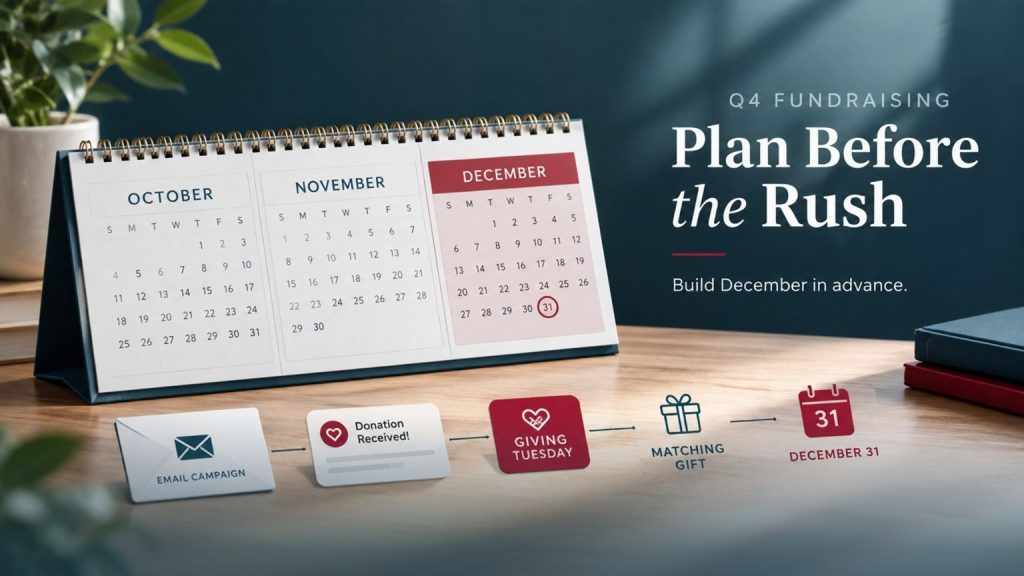
The mistake to avoid is treating year-end fundraising as a single ask that gets sent once, with reminders. A single-touch campaign asks a donor to act in a single moment, on a single motivation. A well-sequenced, multi-touch campaign gives a donor several different reasons to act across several different moments, which is both more effective and, done well, less exhausting for the recipient than it sounds. A workable sequence for the final ten weeks of the year generally includes:
- An early Q4 story or gratitude touch that contains no ask at all, reintroducing the mission and warming the list before any request arrives.
- A Giving Tuesday appeal, distinct in tone and framing from the rest of the sequence, built around the specific energy of that single day.
- A mid-December impact appeal, anchored to one of the stories from your story bank, making the specific case for what a gift accomplishes.
- A matching gift appeal, timed to create urgency around the match deadline rather than the calendar deadline.
- A final December 31 deadline appeal, short, direct, and explicit about the tax-year cutoff, sent on the day itself.
Each touch should do one job and do it clearly, rather than trying to make every argument in every email. Segmentation from the planning phase pays off here directly: a recurring donor might skip the early gratitude touch and go straight into the matching gift appeal, while a lapsed donor’s sequence should lead with a story that reminds her why she gave in the first place before it asks her to give again.
4. Giving Tuesday: standing out on the most crowded day in fundraising
Giving Tuesday has become, by design, the single most crowded day in the non-profit sector’s calendar. Every cause a donor cares about is asking on the same day, in the same inboxes, on the same social feeds. That crowding is precisely why treating Giving Tuesday as just another appeal in the sequence, rather than a distinct project with its own creative approach, is a missed opportunity.
Standing out on Giving Tuesday rarely comes from shouting louder. It comes from being specific when everyone else is generic. An appeal built around one exact, nameable outcome, a specific number of families served, a specific program funded for a specific length of time, cuts through in a way a generic “support our mission today” message does not, because it gives the donor something concrete to picture in a day full of noise. A matching gift specific to Giving Tuesday, separate from any broader December match, gives the day its own reason to act now rather than waiting.
On the single most crowded fundraising day of the year, the organization that says one specific thing clearly beats the organization that says everything loudly. A small development office does not need a viral social campaign to win Giving Tuesday. It needs one clear ask, one clear story, and a plan that was built before the last week of November.
5. The retention trap hiding inside a successful December
Here is the part of year-end fundraising that gets the least attention and deserves the most. A strong December, measured by total dollars raised, can mask a serious problem underneath it, and understanding why requires connecting Q4 fundraising to donor retention data more broadly.
The Fundraising Effectiveness Project, a joint initiative of the AFP Foundation for Philanthropy and GivingTuesday’s Data Commons, has documented for years that new-donor retention across the sector runs low, with the overwhelming majority of first-time donors never giving a second gift. That dynamic applies with particular force to the donor cohort that December disproportionately produces: the once-a-year giver, moved by a specific end-of-year appeal or a Giving Tuesday post, who has no prior relationship with the organization and no reason, absent deliberate follow-up, to develop one.
This is the trap. A development office closes out December, reports a strong total to the board, and moves straight into January’s operational demands without a plan for the wave of new donors that month just produced. Those new December donors are, statistically, exactly the low-retention group the sector’s data warns about. Without a stewardship response, most of them will never be heard from again, and the organization will find itself, next October, starting the acquisition cycle over from scratch rather than building on what December actually created.
The fix has to be built into the plan from the start, not improvised in January after the fact. A January stewardship sequence for new December donors, distinct from your general donor communications, should include a genuine thank-you that goes beyond the tax receipt, an early impact story specific enough to make the connection to their gift obvious, and an invitation into the organization’s ongoing communications, a newsletter, a volunteer opportunity, a way to stay connected that isn’t another ask. Building this sequence in the fall, alongside the rest of the Q4 plan, means it’s ready to deploy the moment December ends rather than becoming the thing that never quite gets done once the holidays are over and the staff is exhausted.
A Deep East Texas example makes the pattern concrete. Picture a regional food pantry ministry that runs an unusually strong Giving Tuesday and December appeal, driven by a specific, well-told story about a family it served, and closes the year having brought in more new donors than any December on record. If that ministry’s plan stops at December 31, most of those new donors quietly disappear by spring, and next year’s team is right back where it started, working just as hard to reach the same total. If instead the ministry has a January sequence ready, a thank-you letter that goes beyond the receipt, a follow-up story in February about where those December gifts went, an invitation to a spring volunteer day, a meaningful share of that new-donor cohort becomes next year’s recurring base instead of this year’s one-time spike. The difference between those two outcomes is not the strength of the December campaign. It’s whether anyone built the bridge into January.
6. A practical Q4 calendar a small development office can execute
Use this as a working checklist, adjustable to your organization’s size and start date, but built on the principle that everything upstream of December should already exist before December begins.
- By early fall: finalize donor segmentation, build a story bank of three to five specific stories, secure a matching gift commitment and confirm the language around it
- By early fall: draft the full email sequence, all touches, subject lines included, and have it reviewed and approved
- By early fall: finalize any print or direct mail piece, allowing enough lead time for design, printing, and postal delivery well before December
- Early October: send the first Q4 touch, a gratitude or story-only email with no ask, to warm the list
- Mid-November: finalize and test the Giving Tuesday plan, including its specific match and its specific story, separate from the general December sequence
- Giving Tuesday: deploy the Giving Tuesday appeal across email and social, anchored to one specific, nameable outcome
- Early-to-mid December: send the impact appeal, anchored in a story from your bank
- Mid-to-late December: send the matching gift appeal, timed to the match deadline
- December 31: send the short, direct, deadline appeal, explicit about the tax-year cutoff
- Prepared in advance, deployed in January: the new-donor stewardship sequence, thank-you, impact story, and an invitation to stay connected beyond the next ask
A calendar like this does not require new software or a bigger team. It requires deciding, before October, what each week is for, so that the team spends December executing a plan rather than improvising one.
7. Close
Q4 will always carry a disproportionate share of a non-profit’s annual revenue, and there is no version of this guide that changes that underlying pattern. What can change is whether an organization meets that season with a system built months in advance or a scramble assembled week to week, and whether the December total gets treated as the finish line or as the starting point for the relationships that will fund next year. The organizations that get this right are not working harder than everyone else in December. They did their hardest work in the summer, and December is where it pays off.
The best year-end campaign is the one nobody on staff was still writing on December 30th.
MSGPR builds year-end fundraising campaigns for non-profits and ministries from the ground up, strategy, segmentation, email sequencing, print and direct mail, Giving Tuesday creative, and social execution, all working from the same plan rather than as separate scrambles. If your organization wants Q4 to build toward January instead of ending on December 31st, now, well before the season starts, is the right time to talk. Call 936-637-7593 or visit msgpr.com.
Sources
- Giving USA 2026: the established pattern of a disproportionate share of annual charitable giving occurring in the fourth calendar quarter
- M+R Benchmarks 2026: email as the dominant digital fundraising channel for non-profit year-end campaigns
- Fundraising Effectiveness Project (FEP), a joint initiative of the AFP Foundation for Philanthropy and GivingTuesday’s Data Commons: donor retention and new-donor attrition data