
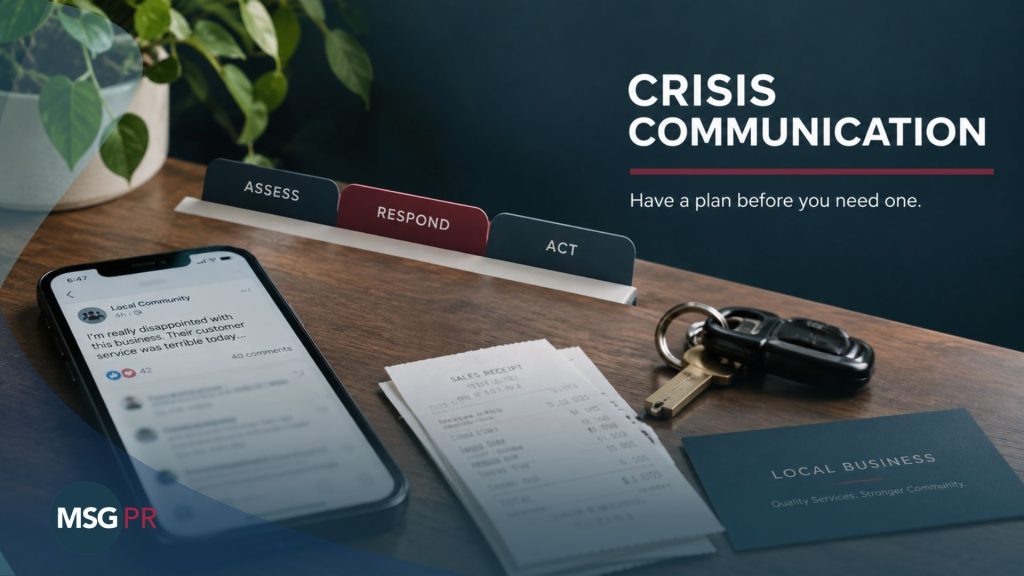
1. The 6:47 a.m. phone call
The text comes in before coffee. A regular customer, someone you actually like, sends a screenshot: a post in the county Facebook group, forty comments deep and climbing, accusing your business of something. Maybe it’s a bad customer service moment that got exaggerated in the retelling. Maybe an employee said something they shouldn’t have. Maybe a product failed and hurt someone, or a delivery truck clipped a mailbox and the driver didn’t stop. Maybe it’s nothing you did wrong at all, just a rumor with legs. Doesn’t matter yet. What matters is that by the time you’ve read the whole thread, forty people have already decided who you are.
You have no legal department. No corporate communications office. No PR retainer sitting on standby. You have a business partner, maybe a manager you trust, and a phone that will not stop buzzing. This is the moment nearly every owner-operator in Deep East Texas will eventually face, usually once, sometimes more than once, and almost never when they’re prepared for it.
Here is the first thing worth knowing, and it should be a relief: the instinct to panic is normal, and the instinct to say nothing until you’ve talked to a lawyer is understandable but usually wrong. What you actually need is not a legal shield. You need a plan, and a plan can be built in an afternoon, long before you ever need it.
This guide walks through the two bodies of research that most professional crisis communicators still lean on, translated out of academic language and into something you can use at 7 a.m. with two people and a phone. Then it gives you the actual framework: what to do in the first 24 hours, and what to do in the weeks after, when the news cycle has moved on but your reputation is still being rebuilt one conversation at a time.
2. What the research actually says: match the response to the responsibility
The single most useful idea in modern crisis communication comes from a researcher named W. Timothy Coombs, who spent decades studying how organizations respond to crises and, more importantly, how audiences respond back. His framework is called Situational Crisis Communication Theory, usually shortened to SCCT, and its core insight is deceptively simple: the right response depends on how much responsibility your organization actually bears for what happened, and how much responsibility the public perceives you to bear. Those are not always the same number, and the gap between them is where most small businesses get into trouble.
Coombs sorts crises into three rough categories. There’s the victim cluster, where something happened to your business through no fault of your own: a natural disaster, workplace violence, malicious rumor, or product tampering by an outside actor. There’s the accidental cluster, where something went wrong but it wasn’t intentional and the organization couldn’t fully have foreseen it: technical error, a process failure. And there’s the preventable cluster, where the organization knowingly took a risk or violated a norm: an employee did something the business should have caught, corners were cut, a known problem was ignored. As responsibility climbs from victim to accidental to preventable, the audience’s anger climbs with it, and so should the strength of your response.
Here’s where owners go wrong in both directions. The first mistake is over-apologizing for something that genuinely was not your fault. If a customer posts an angry, factually wrong account of what happened and you respond with a groveling, defensive apology anyway, you’ve just confirmed guilt in the eyes of everyone reading, and you’ve trained your own community to believe that loud complaints get rewarded regardless of accuracy. The second mistake, far more common and far more damaging, is under-apologizing for something that actually was your fault: getting defensive, minimizing, or going quiet when the facts show real responsibility. That’s the mismatch that turns a bad week into a bad year.
The plain-language version of Coombs’ framework is this: figure out honestly, before you say a single public word, which bucket you’re in. Were you a victim of circumstance, did something slip past reasonable precautions, or did your business actually fail someone. Your answer should shape your tone completely. A business that was the target of a false rumor should correct the record calmly and factually, without excessive apology. A business that made a real mistake owes something closer to full accountability, and trying to split the difference satisfies no one.
One more piece of Coombs’ research matters for small business owners specifically: prior reputation and crisis history function like a bank account. A business with years of goodwill in the community gets more benefit of the doubt on a first offense than a business with a pattern of complaints. That’s not fairness, that’s how trust actually works, and it’s one more argument for treating ordinary day-to-day reputation management as the real crisis prevention plan.
A crisis rarely announces itself with a memo. It shows up as a customer’s screenshot, and by then the story has already started writing itself without you.
3. Benoit’s five moves, and which ones backfire
Where Coombs tells you how to assess a crisis, a communication scholar named William Benoit built the framework for what to actually say once you’ve made that assessment. Benoit’s Image Repair Theory identifies a handful of core strategies organizations reach for when their reputation is threatened, and decades of case studies since have made it fairly clear which ones tend to work and which ones tend to make things dramatically worse.
Denial. Flatly stating that the bad thing didn’t happen, or that your organization wasn’t responsible. This can work when it’s true and you have the evidence to back it up quickly. It is close to fatal when it isn’t true, or when the evidence later contradicts it. Nothing destroys trust in a small market faster than a business owner who denied something that turns out to be documented, on video, or witnessed by half a dozen neighbors who will happily say so in the comments.
Evading responsibility. This covers a family of moves: provocation (“we were provoked into it”), defeasibility (“we didn’t have the information to prevent this”), accident (“it was unintentional”), or good intentions (“we meant well”). These have a narrow, legitimate use when they’re accurate, particularly the accident and defeasibility versions. But used as a dodge when the facts show real fault, they read exactly as evasive as they sound, and audiences are good at smelling the difference between an honest explanation and a excuse dressed up as one.
Reducing offensiveness. This is the largest and most misused category, and it includes bolstering (reminding people of your good record), minimization (arguing it wasn’t as bad as it seems), differentiation (this situation is different from similar-looking bad situations), transcendence (framing it in a larger, more favorable context), attacking the accuser, and offering compensation. Bolstering paired with genuine accountability can help. Minimization and attacking the accuser are the strategies most likely to blow up in your face, because they tend to look like you’re arguing with the people you’ve upset instead of listening to them.
Corrective action. A concrete commitment to fix the problem and prevent it from happening again. This is, according to nearly every case study Benoit and others have examined since, one of the two strategies that most reliably rebuilds trust, and it’s the one small businesses underuse the most. Saying sorry is words. Corrective action is proof, and proof is what a skeptical audience is actually waiting for.
Mortification. A genuine apology, taking responsibility, expressing regret. Paired with real corrective action, this is the other strategy that tends to work, and it works precisely because it’s hard to fake. A real apology has specifics in it: what happened, who it affected, what you’re doing differently. A fake apology is vague, passive-voiced (“mistakes were made”), and focused on how bad the business feels rather than on the person who was actually harmed.
The pattern across decades of Benoit-informed research is remarkably consistent: denial when you’re actually at fault is one of the most reliably damaging moves an organization can make, and genuine corrective action combined with an appropriately sized apology is one of the most reliably effective. Everything else on the list has situational value, but those two data points are the load-bearing wall of this entire field.
4. National crisis and small-town crisis are not the same animal
Most of the popular writing on crisis communications, including the frameworks above, was built by studying airlines, food companies, and Fortune 500 brands managing a national news cycle. That is useful theory, but it is not quite the world MSGPR’s clients live in, and the differences matter enough to spell out plainly.
A national crisis plays out over days or weeks, through a small number of large, relatively slow-moving channels: national news outlets, wire services, a handful of major platforms. There’s usually time, uncomfortable as it feels in the moment, to route a statement through legal review, get executive sign-off, and issue something polished.
A local crisis, the kind an East Texas small business or nonprofit is actually going to face, plays out in hours, through channels that are fast, personal, and permanent in a different way: a community Facebook group, a string of one-star Google reviews, a text chain among people who all know each other and probably know you. The audience isn’t a mass public reading a press release. It’s your neighbors, your kids’ teachers, the people at your church, the other business owners on your chamber board. They are not evaluating a corporate brand. They are evaluating a person they may have met, or think they know something about.
That changes the math on nearly everything. Speed matters more than polish, because in a small community a twelve-hour silence isn’t neutral, it reads as an admission, and it gives the rumor mill twelve unchallenged hours to fill in the story for you. A real, human voice matters more than legal-approved corporate language, because your audience can tell the difference between an owner who sounds like themselves and a statement that sounds like it was written by someone who has never met a customer. And because the audience is a tight, overlapping social network rather than an anonymous mass public, word of mouth after your response spreads through the exact same channels the crisis did, meaning a good response can travel almost as fast as the bad news did.
In a town small enough that everyone already knows your name, the fastest honest sentence you can post will always outperform the most carefully lawyered paragraph you never publish.
This doesn’t mean skip caution. It means the caution has to be different: less “run this past three departments,” more “make sure what we say in the next hour is true, is ours to say, and doesn’t make a promise we can’t keep.” A composite example, built from the kind of situation MSGPR sees across the region: a family-owned service business in a small East Texas town gets a viral local post accusing an employee of rude, possibly discriminatory treatment of a customer. The post is emotional, partly accurate, partly exaggerated, and by lunchtime has hundreds of comments. The owner has two real choices. Wait for a lawyer, stay silent for two days while gathering facts, and let the community story calcify without them. Or get the facts fast, post something honest and specific within a few hours acknowledging what’s known, committing to look into what isn’t, and following up with real action once they know more. In every version of this scenario MSGPR has watched or helped manage, the second path costs less reputational ground, even when the facts turn out to be complicated.
5. The first 24 hours: a real, usable framework
This is the part meant to be printed out and taped inside a filing cabinet door, not filed away and forgotten. It works whether your “crisis team” is twelve people or, more realistically for most of MSGPR’s clients, two or three.
Assess. – Get the facts, fast, from as many direct sources as you can reach in the first hour: employees involved, security footage, receipts, whoever was actually there. Don’t rely solely on the version circulating online. – Honestly place yourself in Coombs’ framework: victim of circumstance, honest accident, or preventable failure. Write the answer down. It will keep you honest later. – Identify who was actually harmed, if anyone, and make them your first priority, ahead of the business’s image.
Assemble your response team, even if it’s small. – Name one person as the single voice of the business for this crisis. Confusion multiplies when two people are answering the same question differently. – Loop in whoever has the facts (a manager, an employee) and whoever will make the final call (the owner). Two or three people, meeting by phone if that’s all there’s time for, is a real crisis team. – Decide who is not going to talk to press, comments, or customers, and tell them clearly. An off-the-cuff comment from an uninformed employee can undo a careful statement.
Craft the first statement fast, not perfect. – Aim for something public within a few hours, not a few days. In a local crisis, silence is read as guilt. – Keep it short: what you know, what you’re doing about it, and a real point of contact. You do not need to have every answer to say something true. – Match the tone to your actual responsibility, per Coombs. If you were wronged, say so calmly and factually. If you were at fault, say so plainly and specifically, and mean it. – Avoid legal hedge-language that sounds like it was written to protect the business rather than address the person. It reads as exactly what it is.
Choose the right channel. – Meet the crisis where it’s happening. If it started in a Facebook group, respond there, not only on your own page. – Use your own channels (website, social, email list) to post the fuller version once you have it, and link back to it from wherever the conversation is live. – For anything involving real harm, injury, or legal exposure, get a phone call or in-person conversation to the affected person directly, before or alongside any public statement. People deserve to hear from you before they read about themselves.
Follow through with real corrective action. – Decide, and say publicly, what specifically changes because of this: a policy, a training, a repair, a refund, a new safeguard. – Set a deadline for that action and actually hit it. A promised fix that never materializes is worse than no promise at all. – If your team is small, this is where a plan drafted calmly in advance pays for itself. Deciding what “we’ll do better” actually means is much harder to do well in the heat of the moment.
Communicate again after the dust settles. – Once you’ve made the fix, say so, briefly and without spiking the football. A short follow-up post closes the loop for anyone still watching. – Reach back out privately to anyone directly affected, separate from the public update. – Debrief with your small team: what worked, what you’d do differently, what needs to be written down for next time.
6. Aftercare: rebuilding trust after the news cycle moves on
Most crisis advice stops at the apology or the statement, as if the job is done once the comments quiet down. It isn’t. The comments quieting down means the public performance is over. Whether trust actually returns is decided in the weeks that follow, mostly by people who are no longer watching the thread.
Follow up with the people who were actually affected, not just the audience. A customer who was mistreated, an employee who was involved, a neighbor whose complaint started it all: a private, specific follow-up two or three weeks later, showing that the corrective action actually happened, does more for genuine trust than any public statement ever will.
Watch for the difference between the crisis ending and the story ending. A Facebook thread going quiet doesn’t mean the version of events people settled on is accurate or fair to you. Keep an ear out, gently, for what the lingering narrative actually is, and correct it calmly if it’s wrong, without relitigating the whole event.
Use the aftermath as evidence, not spin. If you made a real change, mention it naturally in ordinary business communication over the following months, not as a victory lap but as simply what you do now. Consistency over time is what actually closes the credibility gap that a crisis opens.
And build the plan you wish you’d had, while the lessons are fresh. Who’s on the response team. What the decision tree looks like for assessing responsibility. What channels to use. Who has the authority to post the first statement without waiting for a committee that doesn’t exist. Small businesses rarely get hit by the exact same crisis twice, but they often get hit by the same underlying vulnerability: no plan, no assigned voice, no practiced first hour.
7. Close
Every business owner MSGPR has ever sat with after a bad week has said some version of the same thing: I didn’t know what to do first, and by the time I figured it out, other people had already decided the story for me. That’s the entire argument for having a plan before you need one. Not a binder nobody reads, just a clear, small, practiced sense of who speaks, how fast, and what honesty actually requires in your specific situation.
You cannot prevent every bad day. A supplier fails, an employee has a bad moment, a rumor starts for reasons that have nothing to do with the truth. What you can control is whether your response makes things better or worse, and the research is fairly consistent on what makes things better: an honest read of your actual responsibility, a response that matches it, real corrective action, and a human voice willing to say the hard sentence quickly instead of the polished one late.
MSGPR helps clients build a crisis communications plan before they need one, so the first hour of a bad day is spent executing a plan instead of inventing one from scratch. And when a client is already in the middle of it, we help carry the response: crafting the statement, choosing the channel, and staying through the weeks of aftercare that actually rebuild trust. If your business doesn’t have a plan yet, or you’re in the middle of something right now and need a steady outside voice, call 936-637-7593 or visit msgpr.com. We’ve been doing this out of a converted house on Chestnut Street since 1991, and we’ve walked more than a few East Texas businesses through their worst weeks. It gets better, and it gets better faster with a plan.
Sources
- W. Timothy Coombs, Situational Crisis Communication Theory (SCCT)
- William Benoit, Image Repair Theory