
You don’t need to become an SEO expert. But you do need to understand what it is, why it matters, and what it’s doing — or not doing — for your business right now.
Because every day, people in your area are searching for exactly what you sell. And if your business doesn’t show up when they search, someone else’s does.
That’s not bad luck. That’s a fixable problem.
What SEO Actually Means (In Plain English)
Search Engine Optimization is the process of making your business easier for Google to find, understand, and recommend.
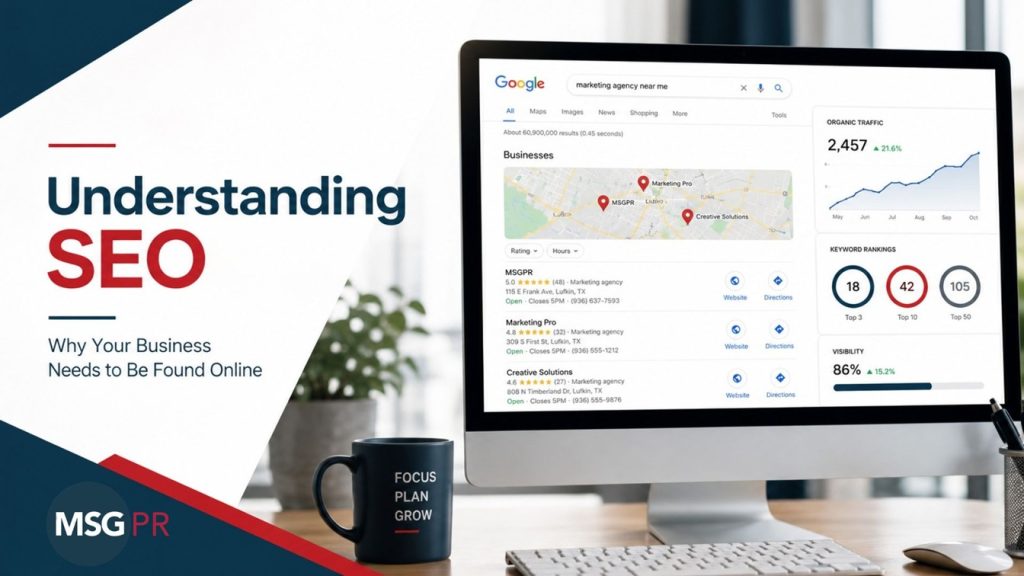
When someone types “marketing agency near me” or “best restaurant in Lufkin” or “commercial electrician East Texas,” Google decides who shows up first. That decision isn’t random. It’s based on hundreds of factors — and the businesses that understand those factors get found. The ones that don’t get buried on page two, which is effectively invisible.
SEO isn’t a trick. It’s not gaming the system. It’s making sure your online presence accurately and thoroughly represents your business so that Google can confidently recommend you to people who are looking for what you offer.
The Things You Can Control Today
There are a handful of SEO fundamentals that don’t require a developer, a consultant, or a budget. They just require attention.
Your Google Business Profile. This is the single most important piece of local SEO real estate you own. If you do nothing else after reading this article, do this: log in to your Google Business Profile and make sure every field is complete. Business name. Address. Phone number. Hours. Categories. Services. Description. Photos.
Then add photos. Real photos. Your storefront. Your team. Your work. Google rewards complete, active profiles with higher visibility. Businesses that post photos to their profile receive significantly more direction requests and website clicks than those that don’t.
Reviews. Ask for them. Not once — systematically. After every completed project, every positive interaction, every satisfied customer. A steady stream of genuine reviews tells Google that your business is active, trusted, and relevant. Respond to every review — positive and negative. Google watches that too.
Your website’s page titles and meta descriptions. These are the headlines and short descriptions that show up in search results. Most small business websites have default or generic titles — “Home” or “Services” or just the company name. That’s wasted real estate.
Every page should have a unique, descriptive title that includes what you do and where you do it. Not stuffed with keywords — written for humans, but informed by what people are actually searching for. “Video Production for East Texas Businesses | MSGPR” tells both Google and the searcher exactly what they’re going to find.
Your content. Google rewards websites that publish useful, relevant, original content on a regular basis. That’s why blogging matters — not because anyone is going to read every post, but because each post is another opportunity for Google to understand what your business does and match it to a search query.
A blog post titled “5 Things to Look for in a Marketing Agency” can rank for searches you’d never think to target with a service page. Over time, those posts compound. They become a library of searchable content that drives traffic to your site while you sleep.
The Layers Beneath the Basics
Everything above is real, and it works. But it’s the surface.
Beneath it is a technical infrastructure that most business owners never see — and that’s where competitive advantage lives.
Site architecture. How your pages are organized, linked to each other, and structured for Google’s crawlers. A poorly organized site confuses search engines the same way a poorly organized store confuses customers. They leave.
Schema markup. This is code that helps Google understand the context of your content — not just what the words say, but what they mean. Is this a business address? A product? A review? An event? Schema doesn’t change what your visitors see, but it changes how Google interprets and displays your information in search results.
Backlink profile. Google treats links from other websites to yours as votes of confidence. The more reputable sites that link to you, the more authority your site carries. Building a healthy backlink profile requires outreach, content worth linking to, and a strategy that unfolds over months and years — not days.
Technical performance. Page speed, mobile usability, security certificates, crawl errors, broken links, redirect chains. These are the invisible mechanics that determine whether Google considers your site trustworthy enough to recommend.
Core Web Vitals. Google’s specific metrics for user experience — how fast your page loads, how quickly it becomes interactive, and how visually stable it is while loading. These are ranking factors, and they require developer-level intervention to optimize.
Competitive analysis. Understanding not just your own SEO position, but where your competitors rank, what keywords they’re targeting, what content is driving their traffic, and where the gaps are that you could fill.
None of this is something you check once and move on from. SEO is an ongoing discipline. The algorithm changes. Your competitors adjust. New search patterns emerge. The businesses that consistently rank well are the ones that consistently invest in staying there.
Understanding SEO is smart. Implementing it across your entire digital presence takes a different kind of time and expertise. Let MSGPR handle the technical work so you can focus on running your business. 936-637-7593.