Over the past ten weeks, we’ve walked through the mechanics of marketing a business.
How to audit what you have. How to build a consistent brand. How to plan social media content. What your website is really saying. How press releases work. Where DIY video works and where it doesn’t. What SEO requires beneath the surface. The difference between PR and advertising. How to build a marketing plan you’ll actually follow.
If you’ve been reading along, you know more about marketing your business than most of your competitors do.
You also know something else — something we didn’t have to say directly, because every article said it for us.
This is a lot of work.
The Time You’re Actually Spending
Let’s be honest about the math.
Managing your own social media — planning, creating, scheduling, engaging — takes a minimum of five to ten hours per week to do well. That’s not a guess. That’s the reality of producing three to five quality posts per week across multiple platforms while responding to comments and messages.
Maintaining your website — updating content, monitoring performance, checking for broken links, optimizing for search, publishing blog posts — takes another three to five hours per week. More if you’re writing the content yourself.
Managing your own email marketing — building campaigns, writing copy, segmenting your list, monitoring deliverability, analyzing results — takes two to four hours per campaign. If you’re sending monthly, that’s a minimum of 24 hours a year just on email.
Handling your own PR — writing releases, building media lists, pitching journalists, following up, managing interview requests — is sporadic but intense. A single media campaign can consume 20 hours or more when you account for the research, writing, outreach, and follow-up.
Running your own ad campaigns — setting up targeting, writing ad copy, designing creative, monitoring spend, adjusting bids, testing variations, analyzing results — takes a minimum of three to five hours per week to manage effectively. More during launch periods.
Add it up. You’re looking at 15 to 25 hours per week. That’s a part-time job. On top of your actual job.
The Cost You Don’t See
Here’s the number no one talks about.
What is your time actually worth?
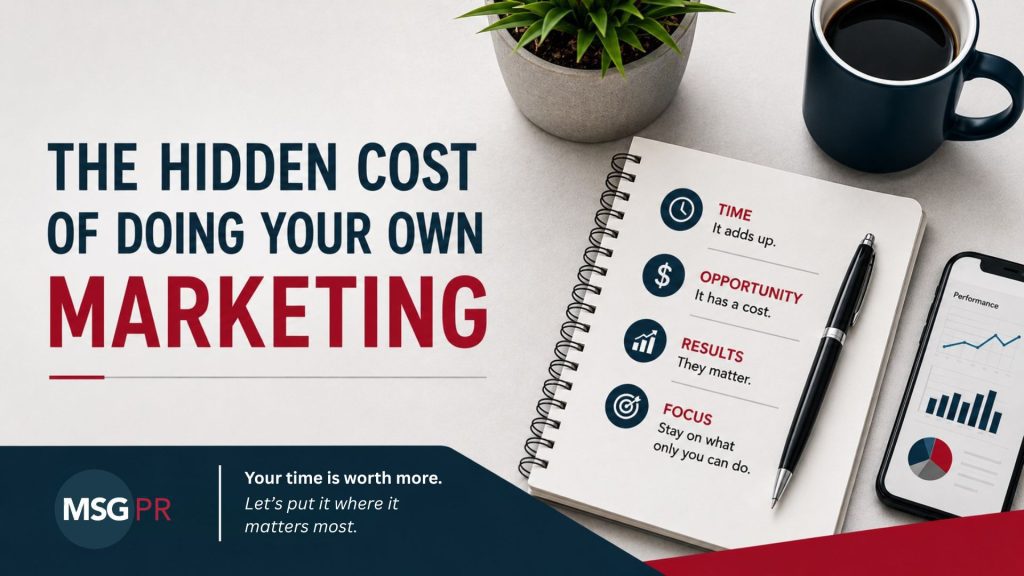
Not your hourly rate in a philosophical sense. Your actual economic value. If you’re a business owner generating $200,000 a year and you work 50 hours a week, your time is worth roughly $77 per hour. Every hour you spend writing a social media caption is an hour you’re not spending on sales, client relationships, strategic decisions, or the work that actually grows your revenue.
At 15 hours a week, that’s $1,155 in opportunity cost. Per week. Over $60,000 a year in time that could have been spent doing what only you can do — running and growing your business.
And that calculation assumes you’re doing the marketing as well as a professional would. In most cases, you’re not. Not because you’re not capable — but because marketing is a skill set that takes years to develop, just like whatever skill set built your business.
The Mistake Tax
DIY marketing doesn’t just cost time. It costs results.
An ad campaign that’s poorly targeted doesn’t just waste the ad spend — it generates zero return. A website that’s not optimized for search doesn’t just miss traffic — it hands that traffic to your competitors. A brand that’s inconsistent doesn’t just look messy — it actively erodes the trust you’ve spent years building.
These aren’t hypothetical costs. They’re happening right now in businesses across every industry, in every market. Business owners who are working hard, doing their best, and still not seeing the growth they expected — because the execution isn’t at the level the strategy requires.
The gap between knowing what to do and doing it at the level that produces results is where money disappears. Not in big dramatic failures, but in slow, invisible leaks that compound over months and years.
The Comparison That Matters
The question isn’t “can I do this myself?”
You can. We’ve spent ten weeks proving it. You have the frameworks, the checklists, the strategies. It’s all real, and it all works.
The question is “should I?”
And the answer depends on what you value most.
If you value control and have the time, the creative energy, and the strategic bandwidth to execute at a high level consistently, do it yourself. Genuinely. These articles weren’t bait. They were education. Use them.
But if you value your time, your focus, and your ability to do the work that only you can do — the work that actually generates revenue and builds your business — then the smart move is to let someone else carry the marketing.
Not someone who will learn on your dime. Someone who already knows. Someone who’s been doing this for decades. Someone who has the systems, the relationships, the creative talent, and the strategic depth to execute at a level you’d need years to reach on your own.
What Hiring a Partner Actually Looks Like
Working with a marketing firm isn’t handing over the keys and hoping for the best. It’s a partnership.
You bring the knowledge of your business, your customers, and your goals. We bring the strategic thinking, the creative execution, the media relationships, the technical expertise, and the accountability to make sure the plan doesn’t collect dust.
You stay involved. You approve. You provide input. You see the results. But you don’t carry the weight. That’s what changes.
The business owners who grow fastest aren’t the ones who do everything themselves. They’re the ones who know what to hold on to and what to hand off. Marketing is one of the most impactful things you can hand off — because the difference between good and great execution shows up directly in your revenue.
You’ve done the hard part — you understand what good marketing requires. Now let someone else carry it. MSGPR has been helping East Texas businesses grow since 1991. Let’s put that experience to work for you. 936-637-7593.