Business owners ask this question more than almost any other.
Should I invest in PR? Should I run ads? Where does my money go the furthest?
The honest answer is that they’re not interchangeable, and comparing them directly is like asking whether you need a foundation or a roof. They do different things. You probably need both. And the order matters.
But before you spend a dollar on either, you need to understand what each one actually does — and what it can’t do.
What Advertising Does
Advertising is paid visibility. You’re buying space — on a screen, on a page, on a billboard, in a feed — and putting your message in front of people.
The advantage of advertising is control. You choose the message. You choose the audience. You choose the timing. You choose the platform. You decide exactly what people see, when they see it, and how often.
Advertising is also measurable. Digital advertising especially gives you data — impressions, clicks, conversions, cost per lead, return on ad spend. You can track exactly what your dollars are doing and adjust in real time.
The limitation of advertising is that people know it’s advertising. They scroll past it. They skip it. They’ve developed a filter for anything that looks, sounds, or feels like a sales pitch. Advertising can drive awareness and traffic, but it earns trust slowly.
And the moment you stop paying, the visibility stops.
What PR Does
Public relations is earned visibility. You’re not buying space — you’re earning it by being newsworthy, relevant, or valuable enough that a journalist, editor, or producer decides to feature you.
The advantage of PR is credibility. When a newspaper writes about your business, when a TV station interviews your founder, when an industry publication includes you in a roundup — that carries a weight that advertising can’t replicate. It’s a third party saying “This business is worth paying attention to.” That kind of endorsement builds trust faster than any ad campaign.
PR also has a longer shelf life than most people realize. A media placement lives online. It gets shared. It gets referenced. It shows up in Google search results. A strong feature story can drive awareness for months or years after it’s published.
The limitation of PR is that you don’t control the narrative. You can pitch the story, but the journalist decides the angle. You can suggest the timing, but the news cycle decides the priority. And there’s no guarantee — you can pitch a great story and get nothing back.
PR is also harder to measure directly. You can track media impressions and estimate the value of earned coverage, but the line between a news story and a sale is less direct than a click-to-purchase path in a digital ad.
The Real Answer
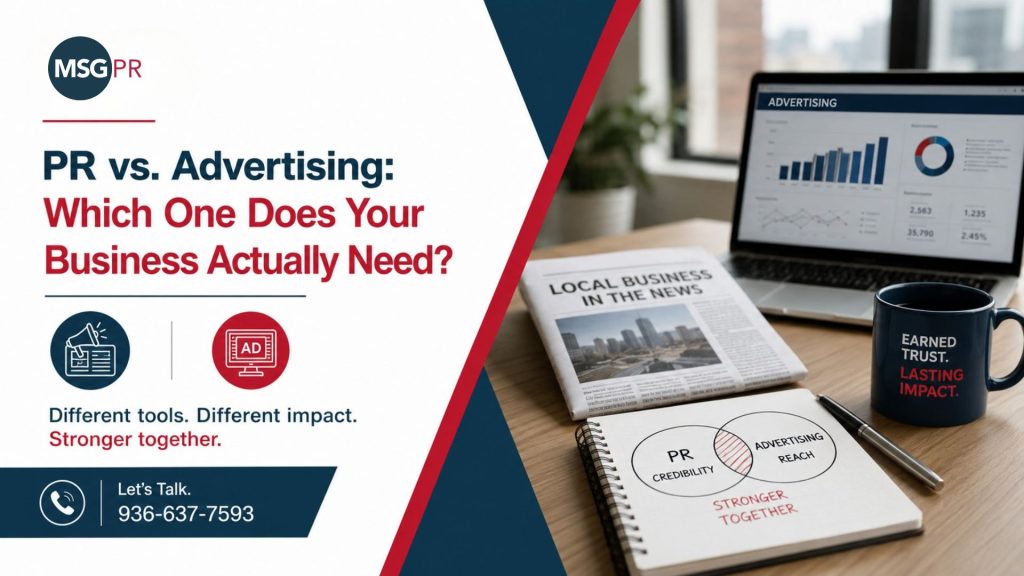
Most businesses don’t need to choose one or the other. They need both, working together.
PR builds credibility. Advertising amplifies the reach. PR earns the story. Advertising makes sure the right people see it.
A business that runs ads but has no media presence is spending money on attention without the authority to convert it. A business that earns media coverage but has no advertising strategy is building credibility without a system to capitalize on it.
The magic is in the integration. A feature story in a local publication becomes a Facebook ad. A media quote becomes a pull quote on your website. A TV segment becomes a video clip in your email marketing. A journalist’s endorsement becomes proof in your sales deck.
But integration requires coordination. Messaging that’s consistent across paid and earned media. Timing that aligns campaign launches with media outreach. A brand voice that sounds the same whether it’s in an ad, a press release, or a social post.
That’s not something that happens by accident.
The Coordination Problem
Here’s where most businesses struggle.
They hire one person to manage their ads. They attempt PR on their own or hire a separate firm. Their social media is handled by someone else entirely. And nobody is talking to each other.
The ad campaign says one thing. The press release says another. The social media doesn’t reference either. The website hasn’t been updated to reflect the current messaging. And the customer — the one person this is all supposed to reach — gets a fragmented experience that doesn’t add up.
Integrated marketing isn’t just a buzzword. It’s the difference between a business that communicates with one clear voice and a business that sounds like five different companies depending on where you encounter it.
The answer is almost never “just PR” or “just ads.” It’s both, working together. MSGPR builds integrated strategies that make every dollar and every story work harder. Let’s talk. 936-637-7593.