A few years back, a manufacturer in this part of the state hired a big agency out of Dallas to handle its rebrand. The work that came back was, by any national standard, polished. The deck had the right typefaces, the right case studies, the right vocabulary about “brand architecture” and “stakeholder alignment.” And it landed with a thud, because the campaign talked about the company’s presence in “the Piney Woods region” the way a tourist talks about a place they read about on a plane. It got the geography right and the people wrong. It didn’t know that the plant’s biggest recruiting problem wasn’t awareness, it was competing with three other employers within a twenty-minute drive who all needed the same skilled welders. It didn’t know which of the two competing weekly papers the plant’s own retirees still read for the obituaries and the high school football scores, and therefore where a goodwill story would actually land. It didn’t know that “Piney Woods” is a phrase outsiders use, not one locals reach for.
None of that is a knock on the talent at that agency. Talented people wrote that plan. The problem wasn’t skill. It was distance, and distance is not something a good creative brief can fully overcome.
Every November, a lot of business owners in Deep East Texas sit down and do the thing this piece is written for: the annual agency review. Is the retainer working? Should we go bigger, go national, go with the firm that pitched us at the trade show with the impressive client logos? It’s a fair question to ask, and this is not going to be a piece that tells you the answer is always “stay local” because loyalty is nice. The honest case for regional expertise is stronger than sentiment, and it’s worth making on the merits.
Why shared frame of reference is a communications advantage, not a nicety
There’s a concept from rhetorical theory that explains, more precisely than “local pride” ever could, why this matters. The mid-twentieth-century rhetorician Kenneth Burke argued that persuasion doesn’t primarily work through clever argument. It works through identification: an audience responds to a communicator to the degree that audience and communicator are, in Burke’s word, consubstantial, sharing enough of the same substance, the same values, language, and lived experience, that the audience feels spoken to rather than spoken at. Burke laid this out at length in A Rhetoric of Motives, and it has held up as one of the more durable ideas in rhetorical theory precisely because it describes something practitioners observe constantly and academics can rarely explain as cleanly.
Put plainly: people trust people who are substantially like them, and they extend that trust, cautiously, to institutions and messages that sound like they come from someone who gets it. This is not a warm, fuzzy add-on to strategy. It is the mechanism by which strategy either lands or doesn’t. A national agency writing to a Lufkin audience is translating. A regional agency writing to that same audience is speaking. The translation can be excellent. It is still translation, and audiences can feel the seam, even when they can’t name it.
This is also why “buy local” as a slogan undersells what’s actually happening. Nobody trusts a business more because its vendor has a Lufkin area code out of civic sentiment alone. They trust it more because the work produced by someone who is substantially of this place tends, in practice, to get the details right that a stranger gets wrong, and those details are exactly what determine whether a message identifies with its audience or merely addresses it.
What “knowing the market” actually means
It’s worth being concrete here, because “we know the local market” is the kind of line every agency says, local or not. What does it actually mean in Deep East Texas?
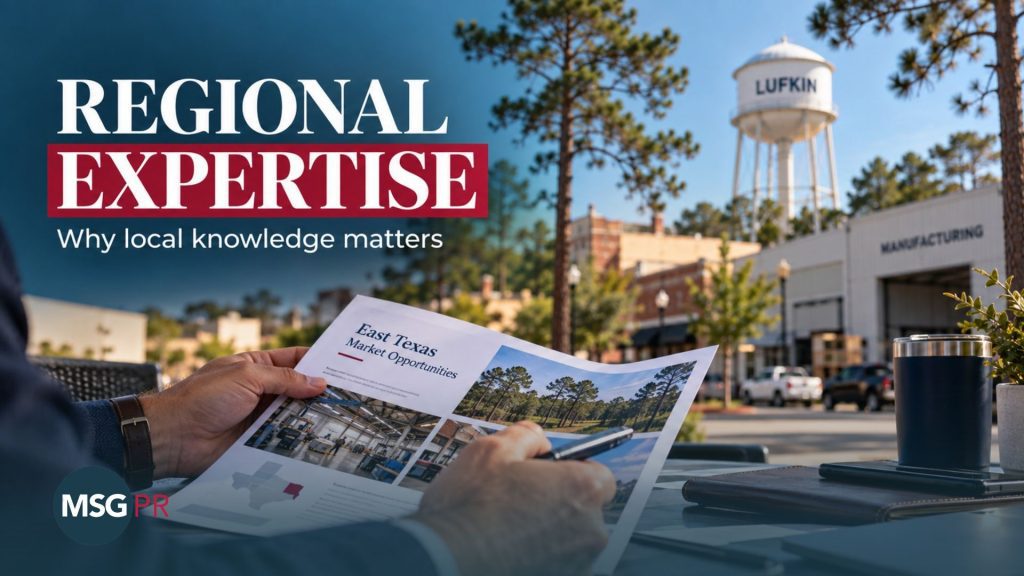
It means understanding that this region’s economy is not one thing. It’s built substantially on timber and forest products, an industry with its own rhythms, its own trade press, its own workforce culture that goes back generations in Angelina County and the surrounding counties. It’s built on oil and gas services, which brings a different audience entirely: contract-driven, safety-obsessed, sensitive to commodity price cycles in ways that shape everything from hiring messaging to sponsorship budgets. It’s built on healthcare, which in a region like this often means a handful of major employers who are also major civic anchors, whose reputations are inseparable from the community’s sense of itself. It’s built on manufacturing and on agriculture, each with its own calendar, its own trade shows, its own definition of a good testimonial.
A national agency can be told these facts in a briefing document. A regional agency has usually sat across the table from someone in each of those industries, has produced work for a timber company and a hospital system and an oilfield services outfit in the same quarter, and carries forward not just facts about the region but a working feel for how a message needs to shift when it moves from one of those audiences to another. That feel doesn’t show up in a research deck. It shows up in the finished work, in word choice, in which local landmark you reference and which you don’t, in whether a testimonial video sounds like it was filmed by someone who understands what a good day looks like on a job site versus someone reading a script about one.
The practical advantages: speed, relationships, and knowing what actually resonates
Set the theory aside for a moment and look at what regional proximity buys a client in ordinary practice.
It buys speed. When a crisis breaks on a Friday afternoon, or a reporter from the regional paper calls with a two-hour deadline, the difference between an agency down the road and an agency three time zones or three states away is not abstract. It’s the difference between someone walking into your building within the hour and someone dialing into a call after your problem has already been sitting for half a day.
It buys relationships that were built in person, over years, not sourced from a media database. A regional agency knows which editor at which outlet actually covers manufacturing news and which one covers it as an afterthought. It knows which radio personality has genuine reach with a working-class audience in this market and which one is popular with an audience that doesn’t overlap with yours at all. That knowledge doesn’t come from a subscription tool. It comes from having sat in the room, sponsored the banquet, made the follow-up call, and done it again the next year.
It buys an understanding of community norms that no national playbook fully captures: what tone a ribbon-cutting release should strike, how a ministry’s messaging needs to differ from a for-profit client’s even when both are asking for the same kind of support, what a Lufkin audience considers appropriately confident versus what reads to them as arrogant showmanship imported from somewhere else. Here’s the short version of it: a message that’s technically correct but locally tone-deaf costs you more than a message that’s imperfect but recognizably yours.
Consider a small East Texas manufacturer weighing a plant expansion and needing to win over both the county commissioners and its own workforce at the same time. The commissioners want to hear about tax base and jobs in terms that match how every other regional expansion has been pitched to them for the last decade. The workforce wants to hear, in plain language, whether this means overtime or layoffs, and they will read corporate jargon as evasion. Getting both audiences right in the same week, with the same underlying facts but two different registers, is exactly the kind of task where an agency that already knows both audiences outperforms one that’s meeting them for the first time through a client questionnaire.
Where a national or specialist agency genuinely makes sense
It would be dishonest to stop there, so here is the honest caveat. There are real situations where a national or specialist firm is the right call, and a good regional agency should be the first to say so.
If a client is launching a genuinely national product with no regional identity to trade on, a firm with deep experience in national media buying and category-specific positioning may bring capabilities that a regional generalist simply hasn’t built at scale. If a client needs highly specialized technical expertise, complex financial-services compliance messaging, or deep expertise in a narrow vertical where the regional agency has no track record, that specialist knowledge can outweigh local fluency. And if a client’s growth ambitions are explicitly about breaking out of the region entirely, an agency with existing relationships in the markets they’re trying to enter has an obvious edge that local knowledge doesn’t answer.
The point isn’t that local always wins. The point is that local wins on the things most regional businesses actually need most of the time: being understood correctly, being reached quickly, and being represented by people who share enough of the same substance with the audience to be trusted rather than merely heard.
How to actually evaluate the tradeoff
For an owner sitting down this November to review the agency relationship, the useful question isn’t “local or national” as an abstract loyalty test. It’s a more specific set of questions. Does this firm understand my industry’s actual rhythms, not just my brand guidelines? Can they get a decision-maker in a room, in person, within a day if something goes wrong? Do they already have real relationships with the specific outlets and platforms that reach my specific audience, or are they building a media list from scratch on my dime? When they write for my customers, does the copy sound like someone who has spent time with people like my customers, or does it sound like a template with our logo dropped in?
If a national firm answers those questions well for your specific situation, that’s a legitimate reason to go that direction. If a regional firm answers them better, that’s not sentiment talking. That’s Burke’s identification doing exactly what the theory predicts it will do: audiences respond to communicators who are substantially like them, and a firm embedded in this region for decades has that substance built in rather than researched.
Where MSGPR fits into that answer
MSGPR has worked out of a converted house on Chestnut Street in Lufkin since 1991, which means the agency evaluating a rebrand for a timber company this year is the same agency that understood the timber industry thirty years ago, and the twenty years before that, and every year in between. That continuity isn’t a marketing line. It’s the reason the work tends to fit the first time instead of needing three rounds of revisions to sound like it belongs here.
Whether the need is public relations and media relations, video and media production, digital marketing, social media management, graphic and print design, book publishing, media digitization, or event production, the same principle applies across every one of those lines: work produced by people who already share your region’s frame of reference starts closer to right. If your agency review this year has you wondering whether a bigger name would serve you better than a firm that already knows this market from the inside, that’s a conversation worth having honestly, on both sides of the table. Call 936-637-7593 or visit msgpr.com to start it.