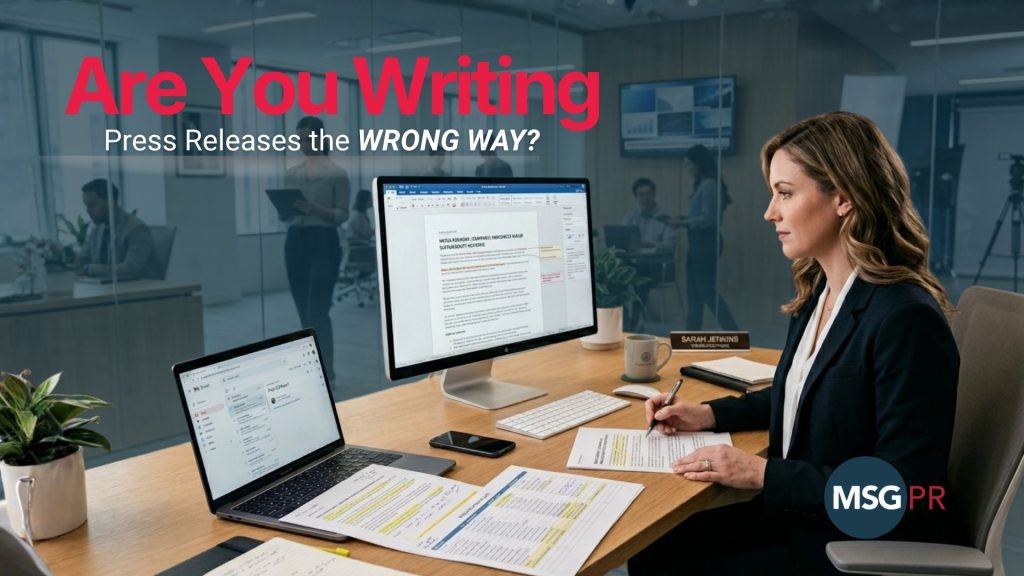
Most press releases end up in the trash.
Not because the news isn’t worth telling. But because the release itself doesn’t give a journalist what they need — quickly, clearly, and without making them work for it.
Media coverage is one of the most valuable things a business can earn. A feature story, a quote in a news article, a segment on local TV — that kind of credibility can’t be bought. But it can be lost with a bad pitch.
Here’s how to write a press release that doesn’t get deleted.
Start With the Newsworthiness Test
Before you write a single word, ask yourself one question: why should anyone outside my company care about this?
Not “why is this important to us.” Not “why are we excited about it.” Why should a reporter — who gets dozens of pitches a day — stop and pay attention?
Newsworthiness usually falls into a few categories. Is it timely? Does it connect to a larger trend or issue? Does it impact the community? Is there a human story behind it? Is there data or a result worth reporting?
A new hire isn’t news. A new hire who’s leading a first-of-its-kind program might be. A company anniversary isn’t news. A company anniversary tied to a story about how the industry has changed over 30 years might be.
If you can’t articulate the “so what” in one sentence, the release isn’t ready.
The Structure That Works
Press releases follow a format for a reason. Journalists are busy. They scan. They need to find the story immediately.
The headline should tell the story in one line. Not be clever. Not be catchy. Just clear. “Lufkin Marketing Firm Launches Free Digital Audit Program for Local Small Businesses” works. “Exciting News from Our Team!” doesn’t.
The first paragraph answers the essential questions: who, what, when, where, and why. Everything a journalist needs to decide if this is worth their time should be in the first four sentences.
The second paragraph adds context — the background, the bigger picture, the reason this matters beyond your company walls.
The third paragraph is your quote. And this is where most press releases fail. A quote should not sound like marketing copy. It should sound like a human being said it out loud. “We’re thrilled to announce this exciting new initiative” is dead on arrival. “Small businesses in this region are spending money on marketing they can’t measure — this program gives them a way to see what’s actually working” sounds like a person with a point of view.
The closing paragraph includes your boilerplate — a brief description of your company — and your media contact information.
That’s it. One page. Maybe two at most. If your press release is three pages long, it’s not a press release. It’s a brochure.
What the Format Won’t Do for You
Here’s where the DIY approach runs into a wall.
You can follow the format perfectly and still get ignored. Because the format gets you in the door. The relationship gets you read.
Journalists have reporters and editors they trust. Publicists and PR professionals they’ve worked with before. People who have demonstrated over years that when they send something, it’s worth opening.
They know which outlets cover which beats. They know that the business editor at one publication cares about economic development stories while the features editor at another is looking for human interest angles on the same topic. They know that calling on a Monday afternoon is better than emailing on a Friday morning. They know which reporters prefer a phone pitch and which ones will block your number if you call unannounced.
This isn’t information you can Google. It’s built over years of pitching, following up, getting rejected, adjusting, and building trust one story at a time.
The Timing Problem
Even with a great release and a good media list, timing matters enormously.
Send your release during a major news cycle and it disappears. Send it too early and it loses urgency. Send it too late and it’s no longer news.
Understanding editorial calendars, news cycles, and the rhythm of local media coverage is a skill that separates the press releases that land from the ones that don’t.
And follow-up is where most DIY efforts die completely. You send the release. You hear nothing. You assume it didn’t work. In reality, the reporter might have flagged it for later but needs a nudge. Or they need a different angle. Or they’d cover it if you could provide a photo or connect them with someone for an interview.
Knowing when to follow up, how to follow up, and when to let it go is the difference between earned media and wasted effort.
Knowing how to write a press release is one thing. Knowing who to send it to — and when — is another. MSGPR has been placing stories in local and national media since 1991. Let’s get your story told. 936-637-7593.