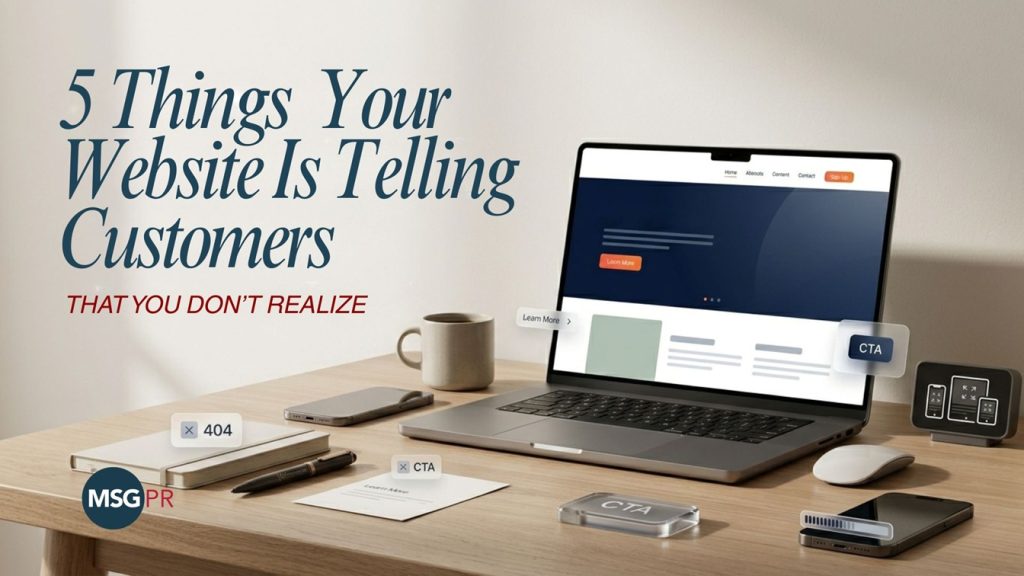
Your website is talking about you behind your back.
Every visitor who lands on your site forms an opinion within seconds. Not about your services. Not about your pricing. About whether you’re worth their time.
And most business owners have no idea what their website is actually saying.
Here are five messages your site might be sending — whether you intended them or not.
1. “We Don’t Respect Your Time”
A slow website isn’t just annoying. It’s a statement.
When a page takes more than three seconds to load, more than half of mobile visitors leave. They don’t wait. They don’t refresh. They go to your competitor’s site — which loaded faster.
Speed is a trust signal. Fast sites feel professional. Slow sites feel neglected. And in a world where people are comparing you to every other business they’ve interacted with online today — including Amazon, Netflix, and their bank — “a little slow” is the same as “not ready for business.”
You can check your site speed for free at Google’s PageSpeed Insights. If your score is below 50 on mobile, your website is actively pushing people away before they read a single word.
2. “We Stopped Paying Attention a While Ago”
Outdated design is a credibility killer.
You might think your website looks fine. But “fine” has a shelf life. Web design trends evolve. User expectations change. What looked modern in 2019 now looks like a relic.
And it’s not just aesthetics. Outdated design often means outdated functionality — broken links, non-responsive layouts on mobile, forms that don’t work, plugins that haven’t been updated in years.
When a potential customer lands on a site that looks like it hasn’t been touched in three years, they don’t think “they’ve been busy.” They think “are they still in business?”
Your website should reflect where your company is right now. Not where it was when you launched it.
3. “We Don’t Actually Want You to Do Anything”
This one is more common than you’d expect.
A visitor lands on your homepage. They read your headline. They scroll a little. They look for the next step. And they find… nothing clear. No obvious button. No specific action. No compelling reason to call, click, schedule, or buy.
A website without a clear call to action is like a store with no checkout counter. You’ve done the work of getting someone through the door, and then you’ve given them no way to do business with you.
Every page on your site should answer one question for the visitor: what do you want me to do next? If the answer isn’t obvious within five seconds, you’re losing people who were ready to act.
4. “We’re Not Who We Say We Are”
Stock photos are easy. They’re also transparent.
When every image on your site looks like it came from a photo library — perfect lighting, diverse models in pristine office settings, handshakes that no human has ever actually performed — visitors notice. Maybe not consciously. But something registers as inauthentic.
Your website should look like your business. Your actual office. Your actual team. Your actual work. Real photos build real trust. They show that you’re a real company with real people doing real work — not a template with a logo swapped in.
This doesn’t mean every photo needs to be professionally shot. A well-lit smartphone photo of your actual team is worth more than a $2 stock image of strangers pretending to collaborate.
But it does mean being intentional about the visual story your site tells. And when the stakes are high — your homepage hero image, your about page, your service pages — professional photography pays for itself in credibility.
5. “We Don’t Know Who We’re Talking To”
This is the deepest problem, and the hardest to see from the inside.
When a website tries to speak to everyone, it connects with no one. Vague messaging like “we provide solutions for your needs” or “quality service you can trust” says nothing specific and everything generic.
Your ideal customer should land on your site and feel like you’re talking directly to them. Their problems. Their industry. Their situation. When the language is specific, it builds instant recognition — “these people understand what I’m dealing with.”
When it’s generic, it creates distance. The visitor thinks “this could be any company” and moves on to one that feels like a better fit.
Writing website copy that speaks to a specific audience requires knowing that audience deeply — not just their demographics, but their frustrations, their goals, their objections, and the language they actually use to describe their problems.
The Hard Truth About Website Strategy
Your website isn’t a project you finish. It’s a tool you maintain.
The businesses that get real results from their websites treat them like living assets. They update content. They test calls to action. They monitor analytics. They refresh design elements. They optimize for search. They revisit their messaging as their business evolves.
The businesses that don’t? Their websites slowly become liabilities — costing them customers they never even knew they had.
Your website is talking to every visitor who finds you. Is it saying what you want it to say? Let MSGPR take a look — no charge, no pressure. Just clarity. 936-637-7593.